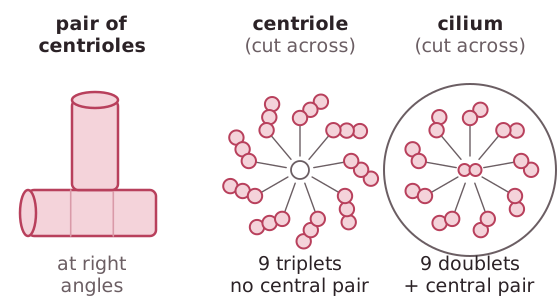
The centrioles are a pair of hollow cylinders made of microtubules, at right angles to each other next to the nucleus of all animal and some protoctist cells.They are present in most eukaryotic cells except flowering plants and most fungi.During cell division they form the centrosome which assembles and organises fibres called the nuclear spindle during cell division.The nuclear spindle is responsible for the movement of chromosomes during cell divisions.Typically, centrioles are made of 9 triplets of microtubules organised with radial symmetry.This differs from the arrangement of microtubules in cilia and flagella.