The Golgi Apparatus is a stack of flattened sacs called cisternae.Vesicles bud off from the rough ER are directed along the cytoskeleton to the Golgi and fuse with the cis face of the Golgi.The Golgi modifies these proteins, for example, by adding carbohydrate chains to form glycoproteins.They are then packaged into Golgi vesicles which bud off the trans face of the Golgi.These vesicles may be secretory vesicles which are transported to the cell membrane by microtubules and fuse with the cell membrane and release their contents to the exterior of the cell by exocytosis.The vesicles could also be lysosomes or contain enzymes used by the cell.
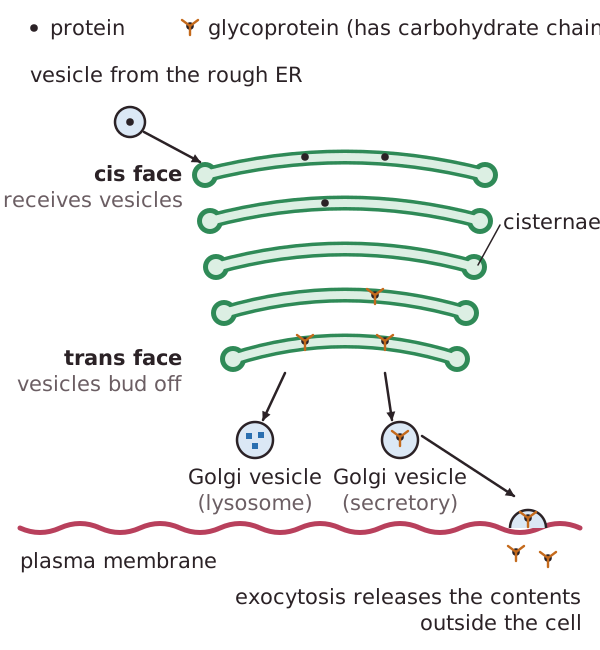
Golgi Apparatus
Read the text
Read the text and highlight anything you think is important. When you go on, the text is hidden and you answer from memory.
Specification: OCR Biology A (H020), AS-level, 2.1.1 Cell structure. Topic: Cell Structure.
Key terms in this lesson
- lysosome
- A vesicle containing hydrolytic enzymes that breaks down waste material, old organelles and pathogens.
- cytoskeleton
- A network of protein fibres in the cytoplasm that gives cells shape, allows movement and anchors organelles.
- rough endoplasmic reticulum
- A network of membranes studded with ribosomes that folds and processes proteins destined for secretion.
- vesicle
- A small, fluid-filled sac bound by a single membrane, used for storage and transport within the cell.
More in Cell Structure
- Cilia and Flagella
- Smooth Endoplasmic Reticulum
- Ribosomes
- Rough Endoplasmic Reticulum
- Plant Cells
- Cellulose Cell Wall
- Vacuole
- Chloroplasts
All 26 lessons in Cell Structure · All OCR AS-level Biology topics