Many species such as humans maintain diploid cells but produce haploid gametes.A diploid cell has two sets of chromosomes with the same genes in the same loci or place. As a result they have two copies of each gene.The haploid gametes fuse during fertilisation to form the diploid zygote that gives rise to all cells. Therefore the nucleus of all cells except gametes contains matching chromosomes called homologous chromosomes.Alleles are different versions of the same gene. Homologous chromosomes may carry different alleles.
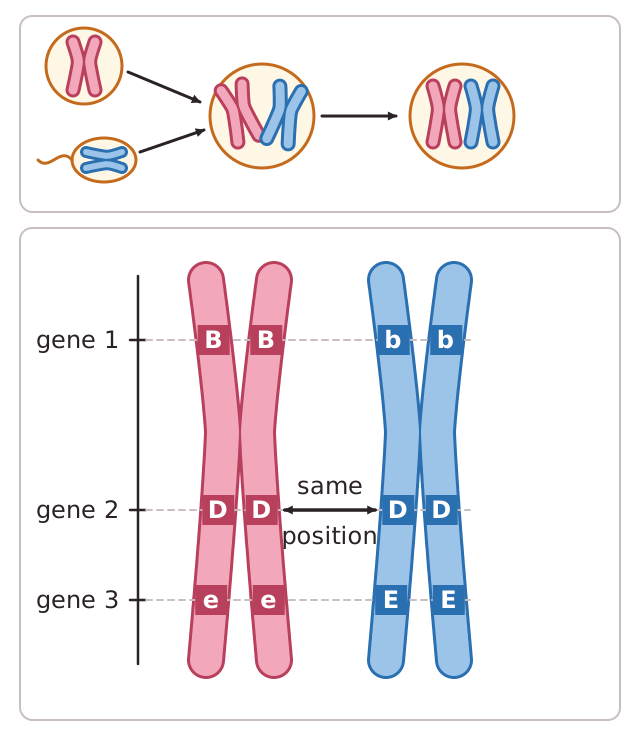
Homologous Chromosomes
Read the text
Read the text and highlight anything you think is important. When you go on, the text is hidden and you answer from memory.
Specification: OCR Biology A (H020), AS-level, 2.1.6 Cell division, cell diversity and cellular organisation. Topic: Cell Division.
Key terms in this lesson
- diploid
- Having two complete sets of chromosomes, one from each parent.
- haploid
- Having a single complete set of chromosomes, as found in gametes.
- gene
- A length of DNA that codes for a specific polypeptide.
More in Cell Division
All 31 lessons in Cell Division · All OCR AS-level Biology topics