The homologous chromosomes are pulled by the shortening of the spindle fibres to either pole centromeres first.
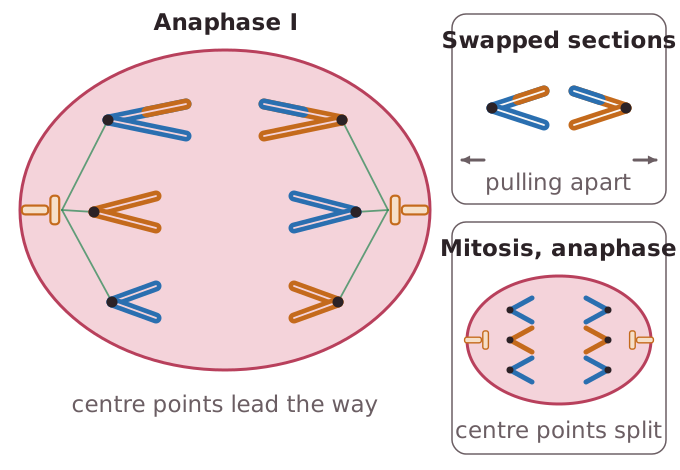
Chromatids stay joined to each other. The chiasmata, where sections of DNA were exchanged by crossing over in prophase 1, separate as the homologous chromosomes move apart.Sister chromatids are no longer identical.
Anaphase 1
Read the text
Read the text and highlight anything you think is important. When you go on, the text is hidden and you answer from memory.
Specification: OCR Biology A (H020), AS-level, 2.1.6 Cell division, cell diversity and cellular organisation. Topic: Cell Division.
Key terms in this lesson
- chromatid
- One of two identical copies of a chromosome, joined by a centromere, formed after DNA replication.
- centromere
- The region of a chromosome that joins two sister chromatids together and attaches to the spindle fibres.
- homologous chromosomes
- A pair of chromosomes, one from each parent, that carry the same genes at the same loci but may carry different alleles.
- crossing over
- The exchange of sections of DNA between non-sister chromatids of homologous chromosomes during prophase I of meiosis, creating genetic variation.
- chiasmata
- The points at which non-sister chromatids of homologous chromosomes become entangled and exchange genetic material during crossing over.
More in Cell Division
- Homologous Chromosomes
- The Stages of Meiosis
- Prophase 1
- Metaphase 1
- Telophase 1
- Meiosis 2
- Specialised Cells and Tissues
- Epithelial Cells
All 31 lessons in Cell Division · All OCR AS-level Biology topics