Skip to content

Prophase 1

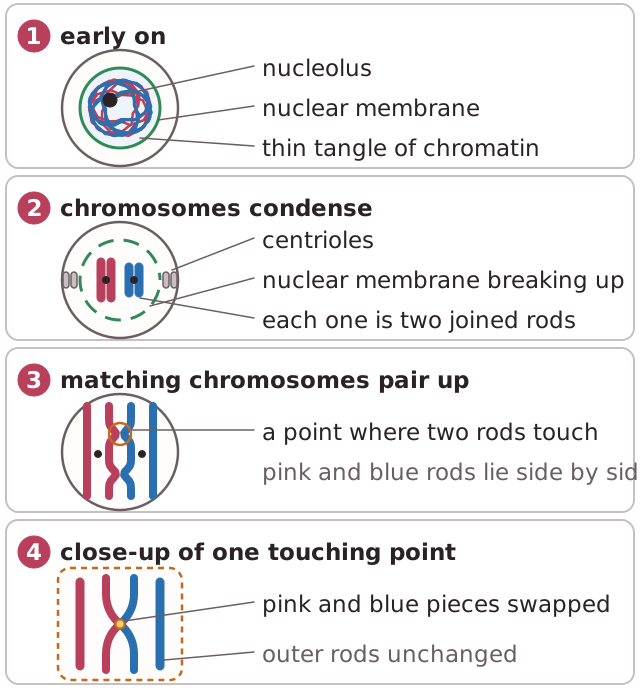
During prophase 1, chromosomes supercoil and condense. They shorten and thicken and become visible under a light microscope as distinct structures.During the S phase of interphase the DNA has replicated so the appearance of the chromosomes is as two sister chromatids joined by a centromere.The nucleolus disappears, the nuclear membrane disintegrates and the centrioles move to opposite poles.Homologous chromosomes pair up and the pairs are called bivalents.The bivalents exchange genetic material by crossing over (entanglement) at points called chiasmata during a process called synapsis. The chromatids cross over, become entangled and break. When they rejoin parts of the chromatids have been exchanged.
Read the text

Read the text and highlight anything you think is important. When you go on, the text is hidden and you answer from memory.

Specification: OCR Biology A (H020), AS-level, 2.1.6 Cell division, cell diversity and cellular organisation. Topic: Cell Division.

Key terms in this lesson

nucleolus
A spherical structure within the nucleus where ribosomal RNA is made and combined with protein to form ribosomes.
centriole
A structure made of microtubules that organises the spindle fibres during cell division.
interphase
The phase of the cell cycle in which the cell grows, carries out its normal functions and replicates its DNA before division.
chromatid
One of two identical copies of a chromosome, joined by a centromere, formed after DNA replication.
centromere
The region of a chromosome that joins two sister chromatids together and attaches to the spindle fibres.

More in Cell Division

All 31 lessons in Cell Division · All OCR AS-level Biology topics