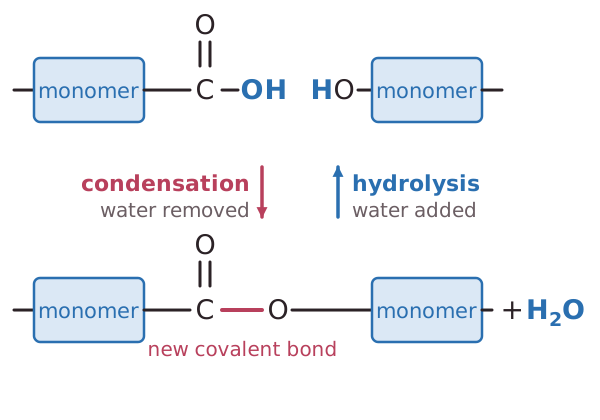
Hydrolysis is a reaction in which a covalent bond is broken by the addition of a water molecule. The water molecule is split: an -H is added to one product and an -OH to the other.Hydrolysis is the reverse of a condensation reaction. Condensation joins monomers together and releases water, while hydrolysis uses water to split polymers back into smaller molecules.Many biological molecules are broken down in this way. Glycosidic bonds in carbohydrates, peptide bonds in proteins, ester bonds in lipids and phosphodiester bonds in nucleic acids can all be hydrolysed. The hydrolysis of ATP to ADP and phosphate also releases energy for cells.In living organisms hydrolysis reactions are catalysed by enzymes, such as amylase, proteases and lipases in digestion. This allows large insoluble molecules to be broken down into small soluble molecules that can be absorbed.