ATP is the immediate energy source of a cell.ATP is a short term energy store because its bonds are unstable. Cells do not store large quantities of ATP and maintain only a few seconds supply. As a result ATP is continuously synthesised.ATP is easily hydrolysed in a single reaction. The reaction has a low activation energy and releases sufficient energy.Glucose releases 2870 kJmol-1 of energy. ATP releases 30.5 kJmol-1 of energy. This is sufficient for most cellular reactions so less energy is wasted.ATP is used for metabolic processes, movement, active transport, secretion and the activation of molecules.
ATP is adenosine triphosphate. It is a nucleotide containing ribose sugar, three phosphate groups on carbon atom-5 and the nitrogen containing base adenine.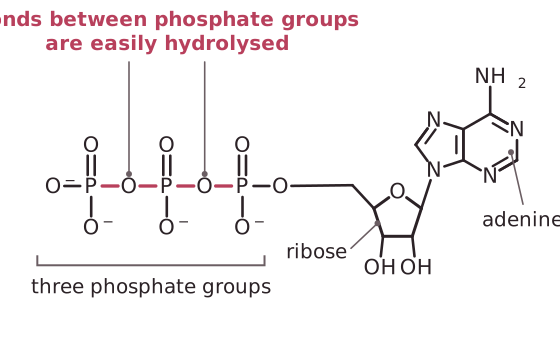
ATP is synthesised by ATP synthase in a condensation reaction. The reaction is the reverse of the hydrolysis reactionADP + Pi + energy → ATP + H2OATP is synthesised in plant and animal cells during processes called phosphorylation.Photophosphorylation occurs during photosynthesis.Oxidative phosphorylation occurs during respiration.Substrate level phosphorylation occurs when phosphate groups from molecules are transferred to ADP.
ATP is adenosine triphosphate. It is a nucleotide containing ribose sugar, three phosphate groups on carbon atom-5 and the nitrogen containing base adenine.
ATP is synthesised by ATP synthase in a condensation reaction. The reaction is the reverse of the hydrolysis reactionADP + Pi + energy → ATP + H2OATP is synthesised in plant and animal cells during processes called phosphorylation.Photophosphorylation occurs during photosynthesis.Oxidative phosphorylation occurs during respiration.Substrate level phosphorylation occurs when phosphate groups from molecules are transferred to ADP.