It is difficult to watch water moving inside a living plant, so simple physical models are used to test whether the cohesion-tension theory is possible.The porous pot model. An unglazed, porous clay pot is filled with water and sealed onto the top of a long, narrow glass tube. The tube is also filled with water, with no air bubbles, and its lower end stands in a beaker of water.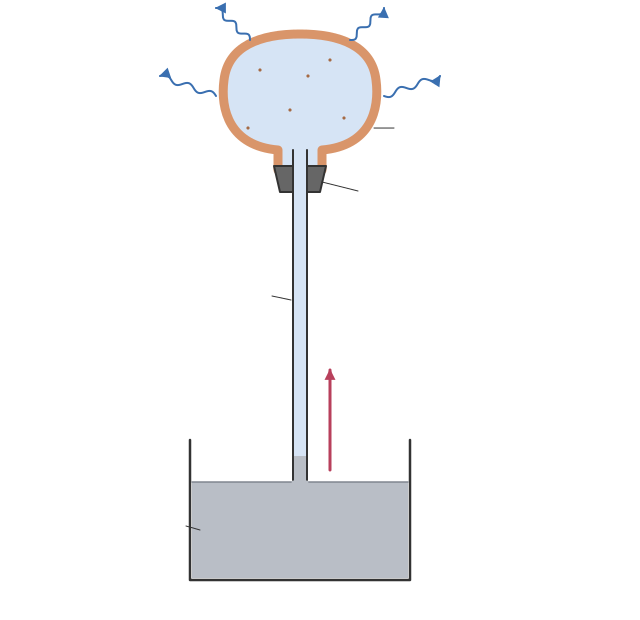
2. the glass tube represents a xylem vessel
3. the beaker of water represents the water in the soil.As water evaporates from the pot, water is drawn from the tube into the pot, and water rises up the tube from the beaker. This shows that evaporation alone, with no living cells, can pull a column of water upwards.If the beaker contains mercury instead of water, the mercury is drawn up the tube. This shows that the water column is under tension and that cohesion holds it together strongly enough to pull a dense liquid.Limitations. The model has no stomata to control water loss, no living cells and no root pressure, and a glass tube is wider and smoother than a real xylem vessel with pits. The model shows the mechanism is possible, but not that it is exactly what happens in a plant.