Root pressure is a pressure that pushes water up the xylem from the roots. It is produced by the living cells of the root and requires energy.It works as follows:1. Cells of the endodermis actively transport mineral ions into the xylem, using ATP from respiration.
2. This lowers the water potential of the solution in the xylem.
3. Water moves into the xylem from the surrounding cells by osmosis.
4. The Casparian strip stops the ions leaking back out through the cell walls, so the extra water in the xylem creates a pressure that pushes water upwards.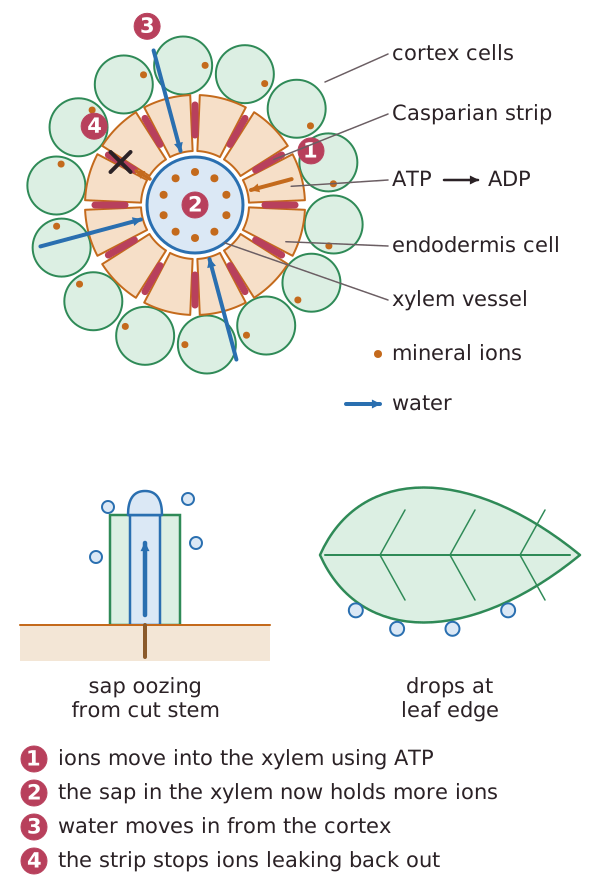 Evidence for root pressure1. When the stem of a well-watered plant is cut just above the soil, sap continues to ooze from the cut end.
2. Some plants lose drops of liquid water from the edges of their leaves, especially at night. This is called guttation.
3. Root pressure increases as temperature rises, and it stops when a respiratory inhibitor such as cyanide is added or when oxygen is removed. This shows it depends on active transport.Importance. Root pressure can only push water up a short distance, so in most plants it makes a small contribution compared with cohesion-tension. It is most important when the rate of transpiration is low, for example at night or in spring before the leaves have opened.
2. This lowers the water potential of the solution in the xylem.
3. Water moves into the xylem from the surrounding cells by osmosis.
4. The Casparian strip stops the ions leaking back out through the cell walls, so the extra water in the xylem creates a pressure that pushes water upwards.
Evidence for root pressure1. When the stem of a well-watered plant is cut just above the soil, sap continues to ooze from the cut end.2. Some plants lose drops of liquid water from the edges of their leaves, especially at night. This is called guttation.
3. Root pressure increases as temperature rises, and it stops when a respiratory inhibitor such as cyanide is added or when oxygen is removed. This shows it depends on active transport.Importance. Root pressure can only push water up a short distance, so in most plants it makes a small contribution compared with cohesion-tension. It is most important when the rate of transpiration is low, for example at night or in spring before the leaves have opened.