Regeneration is the regrowth of lost or damaged body parts by mitosis followed by cell differentiation. In some organisms it is powerful enough to act as a form of asexual reproduction: if the body is broken into pieces (fragmentation), each piece can regrow the missing parts and become a complete new individual.Examples:
• Flatworms (planarians): a planarian cut into several pieces can produce several complete worms, because its body contains many undifferentiated stem cells that divide and differentiate into any tissue needed.
• Starfish: a single arm that includes part of the central disc can regrow into a whole starfish.
• Some segmented worms and sponges reproduce by breaking into fragments.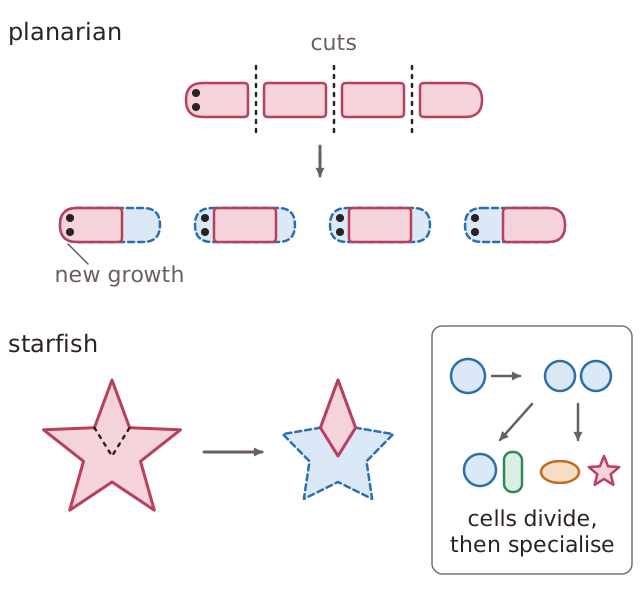 Because every new cell is made by mitosis, the new individuals are genetically identical to the original organism, so fragmentation produces a clone.Regeneration depends on having cells that can still divide and specialise. Organisms with a high regenerative ability keep large numbers of stem cells throughout life. Mammals have limited regeneration: the liver can regrow after part of it is removed, and skin and bone repair after injury, but a lost limb cannot be replaced, because most adult cells are differentiated and adult stem cells are few and restricted in what they can become.Worked example: a planarian is cut into 4 pieces and all of them survive. Each piece regenerates a whole worm, so 4 genetically identical worms are produced from one parent.
• Flatworms (planarians): a planarian cut into several pieces can produce several complete worms, because its body contains many undifferentiated stem cells that divide and differentiate into any tissue needed.
• Starfish: a single arm that includes part of the central disc can regrow into a whole starfish.
• Some segmented worms and sponges reproduce by breaking into fragments.
Because every new cell is made by mitosis, the new individuals are genetically identical to the original organism, so fragmentation produces a clone.Regeneration depends on having cells that can still divide and specialise. Organisms with a high regenerative ability keep large numbers of stem cells throughout life. Mammals have limited regeneration: the liver can regrow after part of it is removed, and skin and bone repair after injury, but a lost limb cannot be replaced, because most adult cells are differentiated and adult stem cells are few and restricted in what they can become.Worked example: a planarian is cut into 4 pieces and all of them survive. Each piece regenerates a whole worm, so 4 genetically identical worms are produced from one parent.