In flowering plants gametes are made inside the flower. The male gametes form inside pollen grains made in the anthers, and the female gamete (the egg cell) forms inside the embryo sac of each ovule, in the ovary.The key difference from animals is the order of cell division. In animals, meiosis produces the gametes directly. In flowering plants:
• diploid mother cells divide by meiosis to produce haploid cells (spores);
• these haploid cells then divide by mitosis to produce the nuclei, including the gametes.Because the cells are already haploid before this mitosis, all the nuclei produced are haploid and genetically identical to the spore they came from.An outline of the two routes:
• Male: in the anther, each pollen mother cell (2n) undergoes meiosis to give four haploid cells, each of which develops into a pollen grain. Mitosis inside the pollen grain produces a tube nucleus and a generative nucleus, and the generative nucleus later divides by mitosis to give two male gamete nuclei.
• Female: in the ovule, one megaspore mother cell (2n) undergoes meiosis to give four haploid cells, three of which degenerate. The survivor divides by mitosis three times to form an embryo sac with eight haploid nuclei, one of which is the egg cell nucleus.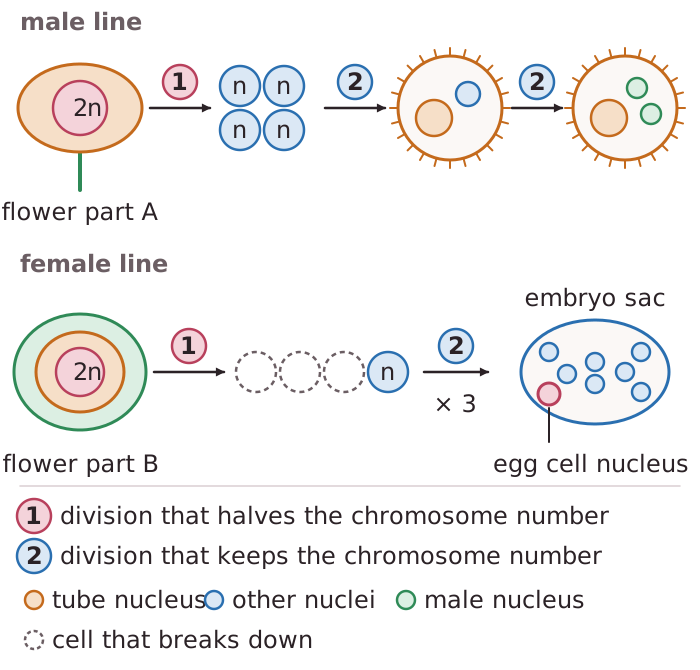 Worked example: a plant with 2n = 14 forms pollen grains, male gametes and an egg cell that each contain 7 chromosomes.The details of each route are covered in the next two lessons.
• diploid mother cells divide by meiosis to produce haploid cells (spores);
• these haploid cells then divide by mitosis to produce the nuclei, including the gametes.Because the cells are already haploid before this mitosis, all the nuclei produced are haploid and genetically identical to the spore they came from.An outline of the two routes:
• Male: in the anther, each pollen mother cell (2n) undergoes meiosis to give four haploid cells, each of which develops into a pollen grain. Mitosis inside the pollen grain produces a tube nucleus and a generative nucleus, and the generative nucleus later divides by mitosis to give two male gamete nuclei.
• Female: in the ovule, one megaspore mother cell (2n) undergoes meiosis to give four haploid cells, three of which degenerate. The survivor divides by mitosis three times to form an embryo sac with eight haploid nuclei, one of which is the egg cell nucleus.
Worked example: a plant with 2n = 14 forms pollen grains, male gametes and an egg cell that each contain 7 chromosomes.The details of each route are covered in the next two lessons.