Spermatogenesis is the production of sperm. It takes place in the seminiferous tubules of the testes, starting at puberty and continuing throughout a man's life. Each tubule is lined by a layer of germ cells called the germinal epithelium, and development proceeds from the outer edge of the tubule towards the central lumen.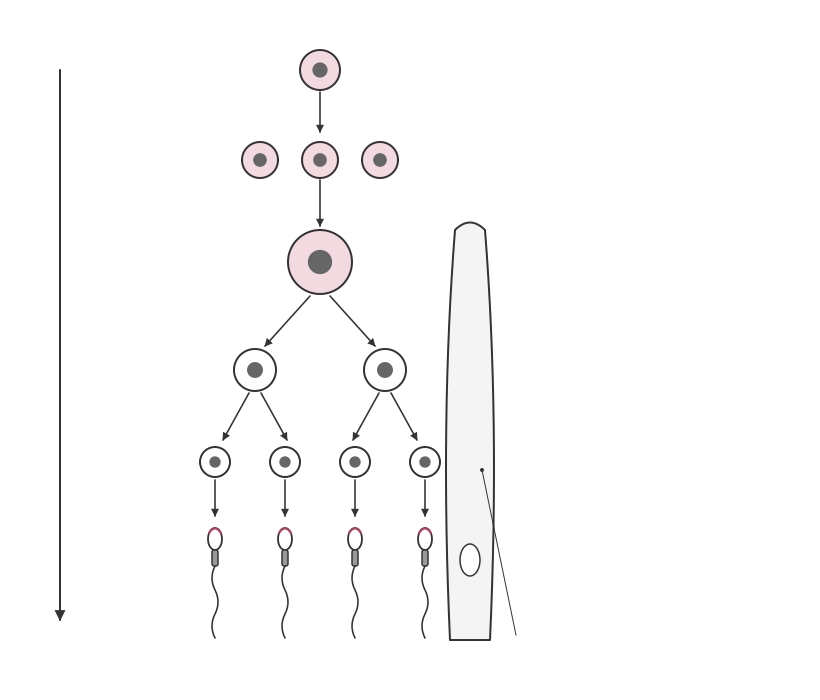
• Multiplication: diploid cells of the germinal epithelium divide by mitosis to form many diploid spermatogonia (2n).
• Growth: some spermatogonia enlarge to form primary spermatocytes (2n), and their DNA replicates.
• Maturation: each primary spermatocyte undergoes meiosis I to form two haploid secondary spermatocytes (n). Each of these undergoes meiosis II to form two spermatids (n).
• Differentiation: spermatids develop into mature spermatozoa, growing a tail and forming an acrosome.So one primary spermatocyte gives four spermatozoa. Large Sertoli cells in the tubule wall nourish and protect the developing cells, and mature sperm are released into the lumen. Interstitial cells (Leydig cells) between the tubules secrete testosterone, which is needed for spermatogenesis.Worked example: in humans, spermatogonia and primary spermatocytes have 46 chromosomes; secondary spermatocytes, spermatids and sperm have 23. If 1000 primary spermatocytes complete meiosis, 1000 × 4 = 4000 sperm are produced.The whole process takes around 64 to 74 days in humans, and millions of sperm are produced every day.