Pollen grains develop inside the anthers of the stamens. A young anther contains four pollen sacs, each filled with diploid pollen mother cells (2n). Around each sac is a layer of nutritive cells, the tapetum, which supplies the developing pollen with nutrients.The stages are:
• Each pollen mother cell divides by meiosis to form a group of four haploid cells, called a tetrad.
• The cells of the tetrad separate, and each becomes an immature pollen grain (a microspore, n).
• The nucleus of each immature pollen grain divides by mitosis, giving a tube nucleus and a generative nucleus.
• A tough two-layered wall forms: a thick outer exine, made of the very resistant substance sporopollenin, and a thin inner intine. The exine protects the grain from drying out and damage, and often has a pattern typical of the species.
• The generative nucleus divides by mitosis to form two male gamete nuclei. In some species this happens before the pollen is released; in others it happens later, inside the pollen tube.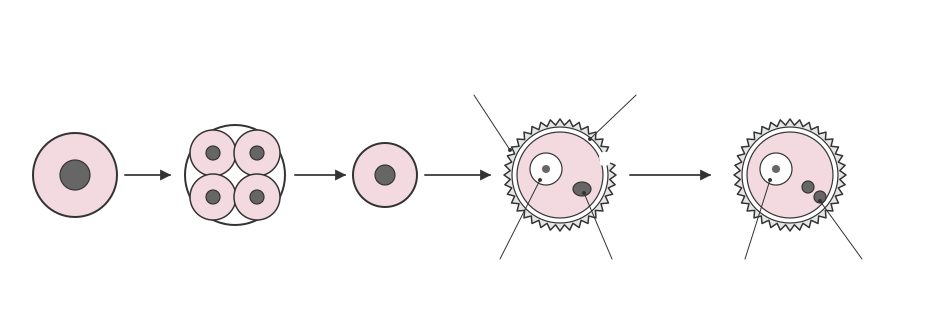
• Each pollen mother cell divides by meiosis to form a group of four haploid cells, called a tetrad.
• The cells of the tetrad separate, and each becomes an immature pollen grain (a microspore, n).
• The nucleus of each immature pollen grain divides by mitosis, giving a tube nucleus and a generative nucleus.
• A tough two-layered wall forms: a thick outer exine, made of the very resistant substance sporopollenin, and a thin inner intine. The exine protects the grain from drying out and damage, and often has a pattern typical of the species.
• The generative nucleus divides by mitosis to form two male gamete nuclei. In some species this happens before the pollen is released; in others it happens later, inside the pollen tube.