Transfer RNA (tRNA) brings amino acids to the ribosome in the correct order during translation.A tRNA molecule is a single strand of about 70 to 90 nucleotides. Parts of the strand fold back and pair with each other by hydrogen bonds between complementary bases, giving a cloverleaf shape with three loops.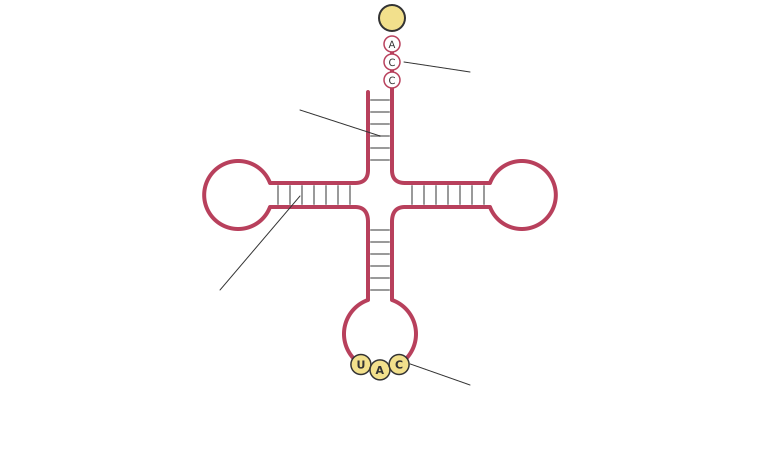
• the anticodon: three unpaired bases on one loop, complementary to a particular codon on mRNA
• the amino acid attachment site: at the 3' end of the strand (the free end, ending in the bases CCA), where one specific amino acid bindsEach type of tRNA has a different anticodon and carries only the amino acid that matches it, so the anticodon links the genetic code to the amino acid. An enzyme attaches the correct amino acid to its tRNA in the cytoplasm, using energy from the hydrolysis of ATP.At the ribosome, the anticodon pairs with the complementary codon on mRNA. After its amino acid has been added to the chain, the tRNA leaves and can collect another amino acid of the same type. tRNA molecules are reused many times.Worked example: the mRNA codon is AUG. The complementary anticodon is UAC, and this tRNA carries methionine.