RNA (ribonucleic acid) is a polynucleotide made of nucleotides containing ribose, a phosphate group and one of the bases A, U, C or G. All RNA is made by transcription from a DNA template, and it is usually single-stranded. There are three main types, each with a different role in protein synthesis:• Messenger RNA (mRNA) is a long, linear single strand. It carries a copy of the genetic code of one gene from the DNA in the nucleus to the ribosomes in the cytoplasm. Its bases are read in codons.
• Transfer RNA (tRNA) is a short strand folded into a cloverleaf shape. Each tRNA carries one specific amino acid to the ribosome and has an anticodon that pairs with a codon on mRNA.
• Ribosomal RNA (rRNA) combines with proteins to form ribosomes, the site of translation. It is the most abundant type of RNA in a cell.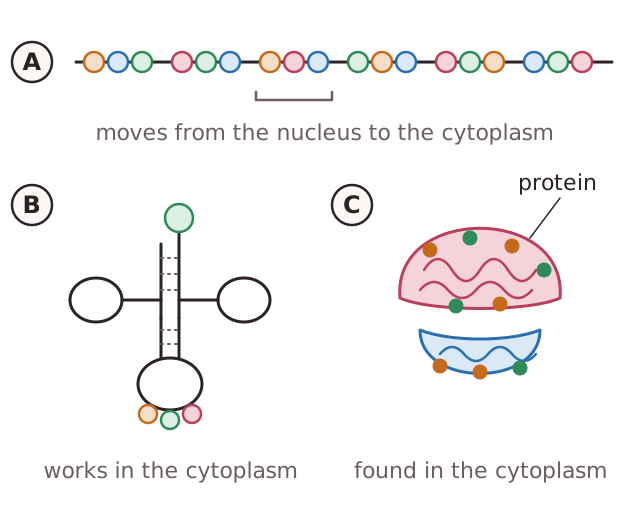 All three differ from DNA in the same ways: they contain ribose rather than deoxyribose, uracil rather than thymine, and they are much shorter than DNA.Worked example: a molecule of RNA has a region of three unpaired bases that bind to mRNA and carries an amino acid at one end. It must be tRNA.
• Transfer RNA (tRNA) is a short strand folded into a cloverleaf shape. Each tRNA carries one specific amino acid to the ribosome and has an anticodon that pairs with a codon on mRNA.
• Ribosomal RNA (rRNA) combines with proteins to form ribosomes, the site of translation. It is the most abundant type of RNA in a cell.
All three differ from DNA in the same ways: they contain ribose rather than deoxyribose, uracil rather than thymine, and they are much shorter than DNA.Worked example: a molecule of RNA has a region of three unpaired bases that bind to mRNA and carries an amino acid at one end. It must be tRNA.