 BRAINCAKE
Active Transport
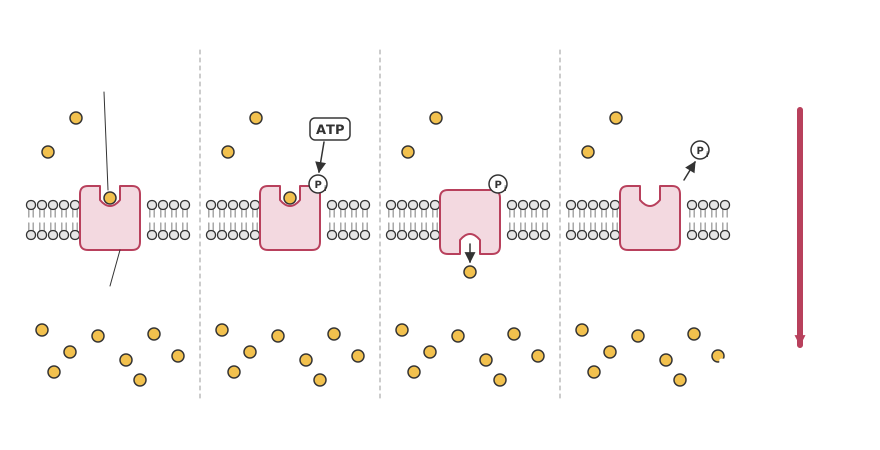
Active transport is the movement of molecules or ions across a membrane from a region of lower concentration to a region of higher concentration, against their concentration gradient, using energy from ATP and specific carrier proteins.
The ATP is made by respiration, so cells that do a lot of active transport have many mitochondria.
How a carrier protein (pump) works:
1. The molecule or ion binds to a specific binding site on the carrier protein, on one side of the membrane.
2. ATP binds to the carrier and is hydrolysed to ADP and inorganic phosphate (Pi). The phosphate attaches to the carrier.
3. This causes the carrier protein to change shape, so it opens to the other side of the membrane.
Sign in free to see the rest of this lesson, the R.E.C.I.P.E. recall steps and the quiz
BrainCake is free. Make an account in seconds and pick up where this page stops.
Key terms in this lesson
- concentration gradient
- The difference in the concentration of a substance between two regions, which determines the direction of net diffusion.
More in Cell Transport Mechanisms
- Osmosis in Animal Cells
- Water Potential in Plant Cells
- Osmosis in Plant Cells
- Turgor Pressure (P)
- Osmotic Potential (π)
- Water Potential, Turgor Pressure and Osmotic Potential
- Evidence for Active Transport
- Endocytosis and Exocytosis
All 18 lessons in Cell Transport Mechanisms · All Edexcel AS-level Biology topics