Skip to content

Osmosis in Plant Cells

When plant cells are placed in solutions of different water potential, water moves by osmosis, but the cell wall changes what happens.
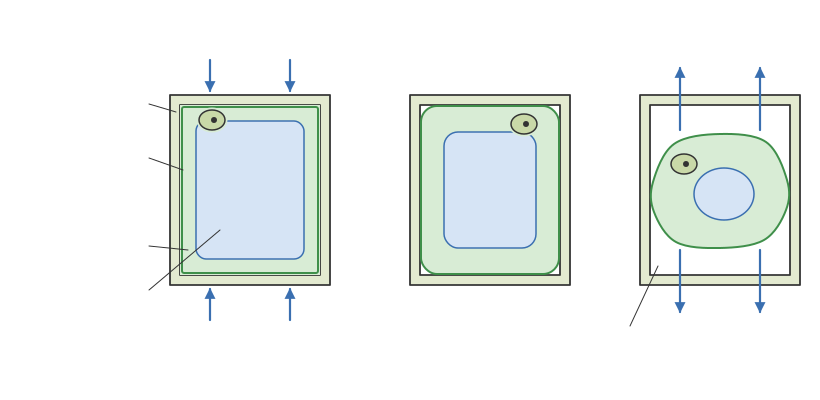
Hypotonic solution (higher water potential than the cell, e.g. pure water): water enters the vacuole and the protoplast (the membrane and everything inside it) swells and presses against the cell wall. The wall is strong and resists, so the cell does not burst. The cell becomes turgid. Turgid cells press against each other and support the plant.Slightly hypertonic solution: the cell loses some water, until the protoplast still touches the wall but no longer presses on it. The cell is flaccid.Hypertonic solution (lower water potential than the cell): water leaves the vacuole and cytoplasm. The protoplast shrinks and pulls away from the cell wall. This is plasmolysis, and the cell is described as plasmolysed. The cell wall is fully permeable, so the space between the wall and the membrane fills with the external solution.The point at which the protoplast just starts to pull away from the wall is called incipient plasmolysis. In a tissue, this is taken as the point where 50% of the cells are plasmolysed. At this point, the water potential of the cells equals that of the solution, so it can be used to estimate the cells' water potential.If a non-woody plant loses more water than it takes up, its cells become flaccid and it wilts.Worked example: onion cells with ψ = −700 kPa are placed in a solution of −1200 kPa. The solution has the lower water potential, so the cells lose water and become plasmolysed.

Read the text

Read the text and highlight anything you think is important. When you go on, the text is hidden and you answer from memory.