 BRAINCAKE
Osmosis in Animal Cells
Animal cells are surrounded only by a cell surface membrane. They have no cell wall, so nothing resists the cell swelling if water enters. Red blood cells show clearly what happens when animal cells are placed in solutions of different water potential.
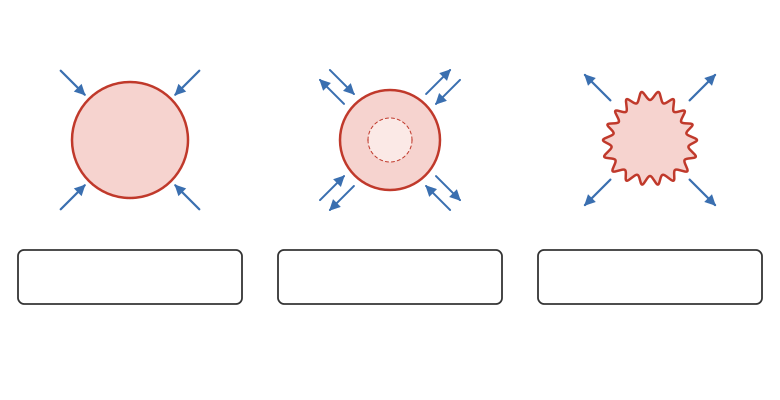
Isotonic solution (same water potential as the cell): water enters and leaves at the same rate, so there is no net movement of water. The cell keeps its normal biconcave shape.
Sign in free to see the rest of this lesson, the R.E.C.I.P.E. recall steps and the quiz
BrainCake is free. Make an account in seconds and pick up where this page stops.
Key terms in this lesson
- hypotonic
- Describing a solution that has a higher water potential than a cell, so water enters the cell by osmosis.
- hypertonic
- Describing a solution that has a lower water potential than a cell, so water leaves the cell by osmosis.
More in Cell Transport Mechanisms
- Water Potential ψ
- Osmosis
- Modelling Osmosis
- Osmotic Concentrations
- Water Potential in Plant Cells
- Osmosis in Plant Cells
- Turgor Pressure (P)
- Osmotic Potential (π)
All 18 lessons in Cell Transport Mechanisms · All Edexcel AS-level Biology topics