Starch is detected with iodine solution, which is iodine dissolved in potassium iodide solution.Method:
1. Add a few drops of iodine solution to the sample (a solution, a suspension, or a solid such as a slice of potato).
2. Observe the colour at room temperature. No heating is needed.Result: if starch is present the colour changes from orange-brown to blue-black. If there is no starch, it stays orange-brown.orange-brown → blue-black = starch present The blue-black colour forms because iodine molecules fit inside the helix of amylose, forming a coloured complex. Glycogen, which has no long helical chains, gives only a reddish-brown colour.Testing a leaf. Boil the leaf in water to kill the cells, then warm it in ethanol (in a water bath, with no naked flame) to remove the chlorophyll so the colour change can be seen. Rinse, spread on a tile and add iodine.Following starch digestion. The test is used to follow the action of amylase. Drops of iodine solution are placed in the wells of a spotting tile, and a drop of the starch–amylase mixture is added every 30 seconds. When a drop no longer turns blue-black, all the starch has been hydrolysed. The time taken is used to work out the rate:rate = 1 / time Worked example: if the starch has gone after 150 s, the rate is 1 / 150 = 0.0067 s−1.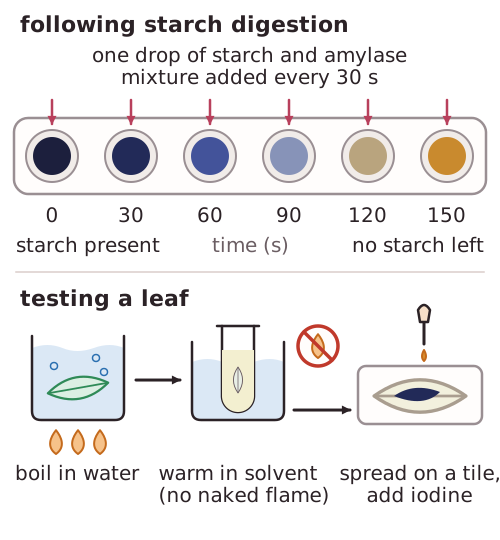
1. Add a few drops of iodine solution to the sample (a solution, a suspension, or a solid such as a slice of potato).
2. Observe the colour at room temperature. No heating is needed.Result: if starch is present the colour changes from orange-brown to blue-black. If there is no starch, it stays orange-brown.