A disaccharide is formed when two monosaccharides join in a condensation reaction. An –OH group on one sugar reacts with an –OH group on the other, a molecule of water is removed, and the two sugars are linked through an oxygen atom by a glycosidic bond.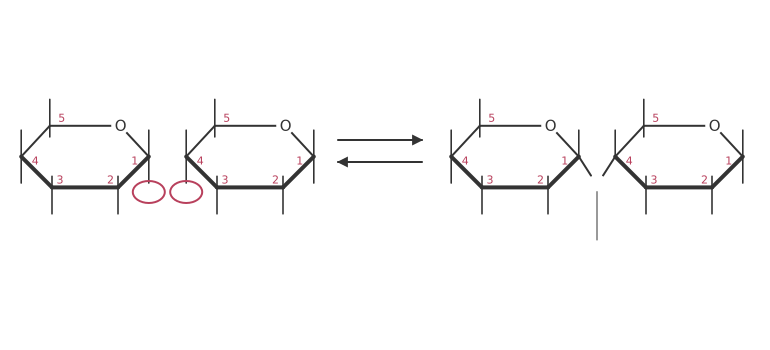
• sucrose = glucose + fructose (the form in which plants transport sugar in the phloem)
• lactose = glucose + galactose (the sugar in milk)The reverse reaction is hydrolysis: adding a water molecule breaks the glycosidic bond and releases the two monosaccharides. In the body this is catalysed by enzymes such as maltase, sucrase and lactase. Boiling with dilute acid also hydrolyses glycosidic bonds.Worked example: the formula of a disaccharide made from two hexoses is found by adding the monosaccharides and removing one water:2 C6H12O6 − H2O = C12H22O11 So maltose, sucrose and lactose all have the formula C12H22O11, even though their structures differ.Like monosaccharides, disaccharides are sweet and soluble. Maltose and lactose are reducing sugars, but sucrose is a non-reducing sugar, because the groups that would make it reducing are used in its glycosidic bond.
• sucrose = glucose + fructose (the form in which plants transport sugar in the phloem)
• lactose = glucose + galactose (the sugar in milk)The reverse reaction is hydrolysis: adding a water molecule breaks the glycosidic bond and releases the two monosaccharides. In the body this is catalysed by enzymes such as maltase, sucrase and lactase. Boiling with dilute acid also hydrolyses glycosidic bonds.Worked example: the formula of a disaccharide made from two hexoses is found by adding the monosaccharides and removing one water: