 BRAINCAKE
Water and Hydrogen Bonding
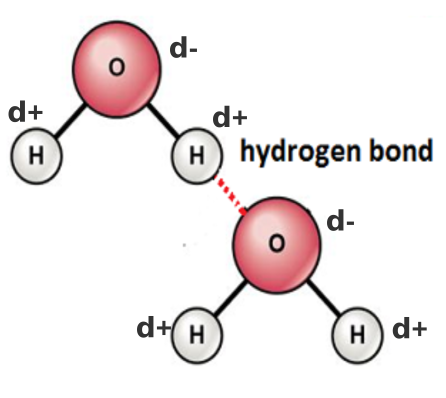
Water is a polar molecule.
It is a covalent molecule with no overall charge but there is a slightly uneven distribution of electrons between the oxygen atom and the hydrogen atoms. This makes the hydrogen atoms slightly positive and the oxygen atom slightly negative.
Sign in free to see the rest of this lesson, the R.E.C.I.P.E. recall steps and the quiz
BrainCake is free. Make an account in seconds and pick up where this page stops.
Key terms in this lesson
- hydrogen bond
- A weak electrostatic attraction between a slightly positive hydrogen atom on one polar molecule and a slightly negative atom, such as oxygen or nitrogen, on another.
- specific heat capacity
- The energy needed to raise the temperature of 1 kg of a substance by 1 degree Celsius.
- latent heat of vaporisation
- The energy needed to evaporate 1 kg of a liquid without a change in temperature.
- cohesion
- The attraction between molecules of the same substance, in water caused by hydrogen bonding.
More in Nucleic Acids
- Evidence for Semi-Conservative Replication
- ATP
- ATP Synthesis
- Roles of ATP
- Specific Heat Capacity of Water
- Latent heat of Vaporisation of Water
- Cohesion and Surface Tension of Water
- The Importance of Water
All 18 lessons in Nucleic Acids · All AQA AS-level Biology topics