 BRAINCAKE
RNA
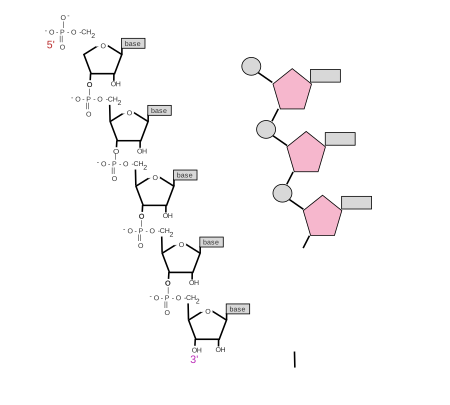
RNA is a polynucleotide.
The pentose sugar is ribose and the nucleotides are joined by phospodiester bonds.
RNA contains four nitrogen-containing bases, adenine, cytosine, guanine and uracil.
Sign in free to see the rest of this lesson, the R.E.C.I.P.E. recall steps and the quiz
BrainCake is free. Make an account in seconds and pick up where this page stops.
Key terms in this lesson
- nucleotide
- A molecule made of a pentose sugar, a phosphate group and a nitrogen-containing base.
- nucleolus
- A dense structure within the nucleus where ribosomal RNA is made and ribosomes are assembled.
- ribosome
- A small organelle, made of RNA and protein, that is the site of protein synthesis.
- gene
- A length of DNA that codes for a polypeptide or a functional RNA molecule, at a specific locus on a chromosome.
More in Nucleic Acids
- Nucleotides
- DNA
- Complementary Base Pairing
- Stability of the Double Helix
- Function of DNA
- Discovering DNA as the Hereditary Material
- DNA Semi-Conservative Replication
- Evidence for Semi-Conservative Replication
All 18 lessons in Nucleic Acids · All AQA AS-level Biology topics