In eukaryotes, transcription results in pre-mRNA which is a length of RNA with both non-coding and coding sequences.The non-coding sequences are called introns and need to be spliced out to make functional mRNA.The introns are removed and the coding sequences called exons are joined together.The mRNA leaves the nucleus through the nuclear pore.
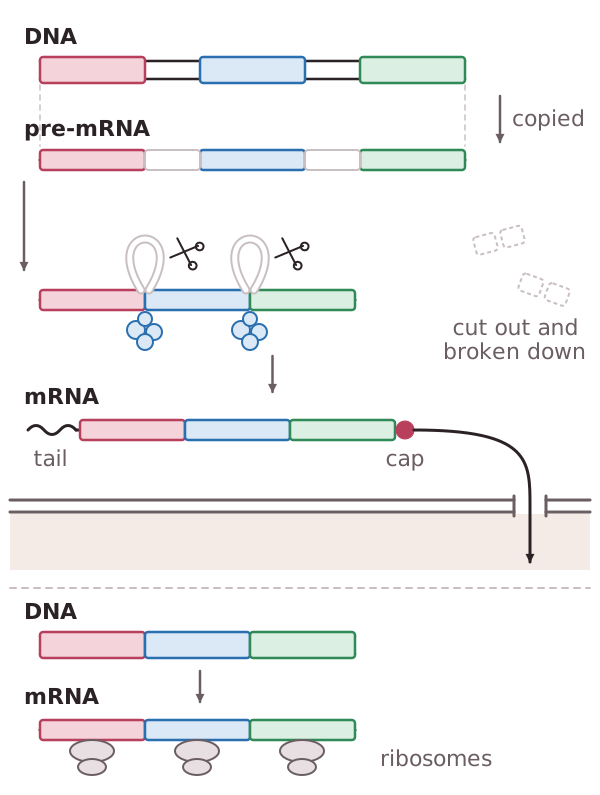
In prokaryotes the mRNA has no introns so splicing does not take place.
Splicing pre-mRNA
Read the text
Read the text and highlight anything you think is important. When you go on, the text is hidden and you answer from memory.
Specification: AQA Biology (7401), AS-level, 3.4.2 DNA and protein synthesis and 3.4.1 DNA, genes and chromosomes. Topic: DNA, Genes and Protein Synthesis.
Key terms in this lesson
- prokaryotic cell
- A cell, such as a bacterium, that lacks a nucleus and membrane-bound organelles and has a single loop of circular DNA.
- eukaryotic cell
- A cell that has a nucleus and membrane-bound organelles.
- transcription
- The synthesis of a complementary strand of mRNA from a DNA template, catalysed by RNA polymerase.
More in DNA, Genes and Protein Synthesis
All 15 lessons in DNA, Genes and Protein Synthesis · All AQA AS-level Biology topics