Skip to content

Ribosomes

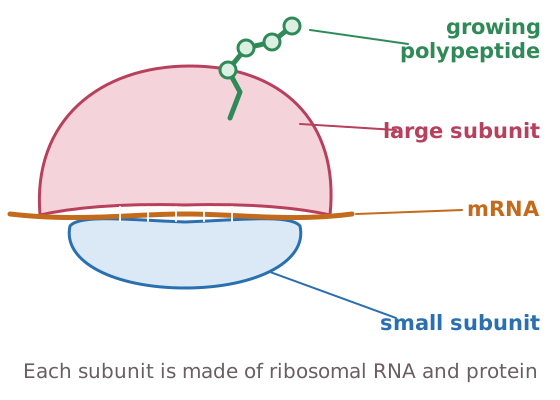
Ribosomes are the site of protein synthesis.They are either free in the cytoplasm or attached to the rough endoplasmic reticulum in eukaryotes.They are made in the nucleolus from ribosomal RNA (rRNA) and protein.Each ribosome is made from a large subunit and a small subunit. The large subunit contains the enzyme peptidyl transferase which joins amino-acids together to form proteins.Mitochondria and chloroplasts also contain ribosomes.The mitochondrial ribosomes of eukaryotic cells are distinct from their other ribosomes. They functionally resemble those in bacteria, giving rise to the evolutionary theory of the origin of mitochondria as endosymbiotic bacteria.
Read the text

Read the text and highlight anything you think is important. When you go on, the text is hidden and you answer from memory.

Specification: AQA Biology (7401), AS-level, 3.2.1.1 Structure of eukaryotic cells. Topic: Cell Structure.

Key terms in this lesson

nucleolus
A dense structure within the nucleus where ribosomal RNA is made and ribosomes are assembled.
rough endoplasmic reticulum
A network of membranes studded with ribosomes, continuous with the nuclear envelope, involved in the synthesis and transport of proteins.
eukaryotic cell
A cell that has a nucleus and membrane-bound organelles.

More in Cell Structure

All 26 lessons in Cell Structure · All AQA AS-level Biology topics