 BRAINCAKE
Lysosomes
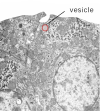
Vesicles are fluid filled sacs formed from single membranes.
They are used for storage and transport.
They may bud off from other membranous organelles called the endoplasmic reticulum and the Golgi apparatus and contain lipids or peptides.
Sign in free to see the rest of this lesson, the R.E.C.I.P.E. recall steps and the quiz
BrainCake is free. Make an account in seconds and pick up where this page stops.
Key terms in this lesson
- Golgi apparatus
- A stack of membrane-bound sacs that modifies, packages and transports proteins and lipids, forming secretory vesicles and lysosomes.
- pathogen
- A microorganism, such as a virus, bacterium, fungus or protoctist, that causes disease.
- phagocytosis
- The process by which a phagocyte engulfs and digests a pathogen or foreign particle.
More in Cell Structure
- Mitochondria
- Chloroplasts
- Endoplasmic Reticulum
- Golgi Apparatus
- Ribosomes
- Cell Wall
- Vacuoles
- Cell Structure and Function
All 26 lessons in Cell Structure · All AQA AS-level Biology topics