Large particles and bacteria can be engulfed by phagocytosis.Phagocytes move in a particular direction down a chemical gradient. This is called chemotaxis and is caused by a chemoattractant being released in one location.Phagocytes can recognise chemicals on the surface of bacteria such as bacterial lipopolysaccharides which are the major outer surface membrane components present in almost all Gram-negative bacteria.The phagocyte engulfs the pathogen in a vesicle called the phagosome. Lysosomes from inside the cell move towards the phagosome and fuse with it.Lysozyme within the phago-lysosome digest and destroy the pathogen by hydrolysis.The soluble products are absorbed into the cytoplasm of the phagocyte.
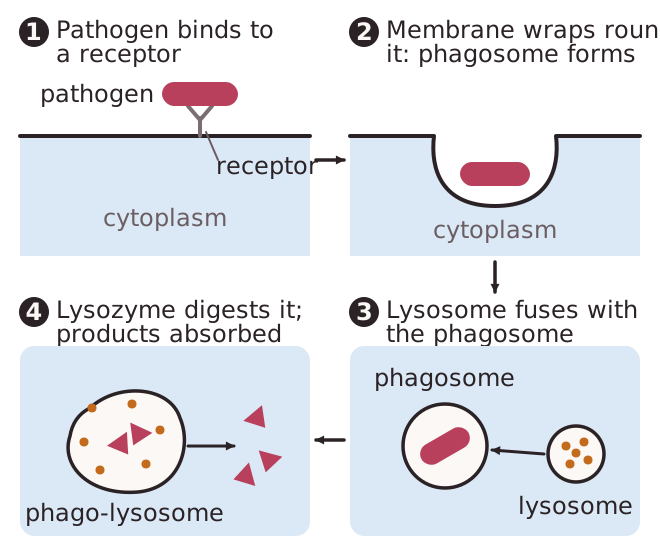
Phagocytosis
Read the text
Read the text and highlight anything you think is important. When you go on, the text is hidden and you answer from memory.
Specification: AQA Biology (7401), AS-level, 3.2.4 Cell recognition and the immune system. Topic: Cell Recognition and the Immune System.
Key terms in this lesson
- hydrolysis
- The breaking of a covalent bond within a molecule using a water molecule.
- lysosome
- A vesicle containing hydrolytic enzymes that breaks down waste material, old organelles and pathogens.
- pathogen
- A microorganism, such as a virus, bacterium, fungus or protoctist, that causes disease.
More in Cell Recognition and the Immune System
- The Immune System
- Defence Mechanisms
- Lymphocytes and Phagocytes
- Recognising Self and Non-Self Cells
- Antigens
- Lymphocytes
- Cell-Mediated Immunity
- Cytotoxic T-cells
All 30 lessons in Cell Recognition and the Immune System · All AQA AS-level Biology topics