A mutation is a change in the sequence of bases in DNA.
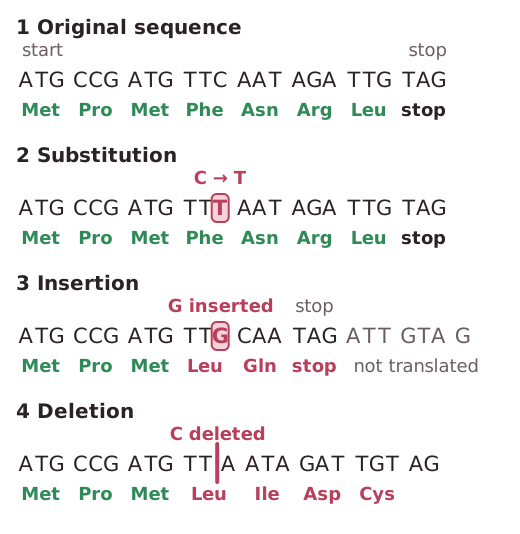
If the mutation occurs within a gene then the protein synthesised may be affected. The mutation may be a substitution, deletion or insertion (addition). A mutation affecting only one nucleotide is called a point mutation.
A substitution of a single nucleotide may or may not produce a codon that codes for a different amino-acid. This will lead to a different primary structure. The new amino-acid will only significantly affect the protein if the R group is very different e.g. a non-polar R group replacing a polar R-group.
An insertion or deletion will cause a frameshift mutation unless a multiple of 3 bases is inserted or deleted. This will almost certainly affect the structure of the protein.