Temperature affects the rate of photosynthesis mainly through the enzymes of the Calvin cycle, such as RuBisCO. The light-dependent stage is affected much less, because light absorption by chlorophyll does not depend on temperature.Low temperatures: molecules have less kinetic energy, so there are fewer successful collisions between enzymes and substrates. Fewer enzyme-substrate complexes form and the Calvin cycle runs slowly. Levels of GP, TP and RuBP all fall because every enzyme-controlled step slows.Rising temperature: up to an optimum (around 25 °C for many temperate plants), the rate increases because enzymes and substrates collide more often. Between about 10 °C and 30 °C the rate roughly doubles for each 10 °C rise, a temperature coefficient (Q10) of about 2.Above the optimum: the rate falls for several reasons.• Photorespiration increases: RuBisCO binds oxygen instead of carbon dioxide more often at high temperatures, wasting RuBP and reducing GP production.
• Stomata close to reduce water loss, so less carbon dioxide diffuses into the leaf.
• At very high temperatures, enzymes denature as hydrogen bonds in their tertiary structure break, and thylakoid membranes can be damaged.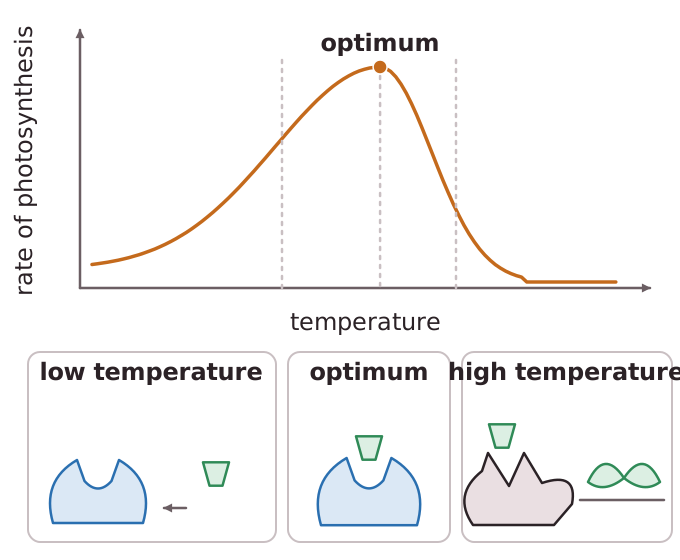 Worked example: a plant photosynthesises at 4 units at 15 °C. With Q10 = 2, the rate at 25 °C is 4 × 2 = 8 units.
• Stomata close to reduce water loss, so less carbon dioxide diffuses into the leaf.
• At very high temperatures, enzymes denature as hydrogen bonds in their tertiary structure break, and thylakoid membranes can be damaged.
Worked example: a plant photosynthesises at 4 units at 15 °C. With Q10 = 2, the rate at 25 °C is 4 × 2 = 8 units.