A food chain shows how energy (and biomass) is transferred from one organism to the next as each is eaten. The arrows point in the direction of energy flow, from the organism that is eaten to the organism that eats it.grass → grasshopper → frog → heron 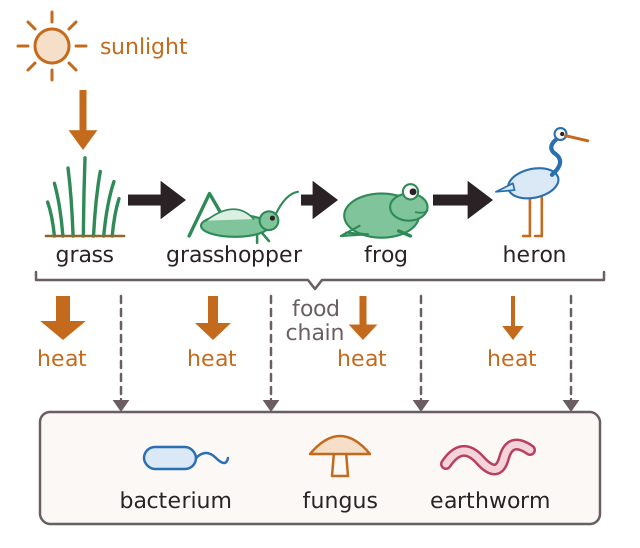 Each stage in a food chain is a trophic level:
- Producers (trophic level 1): photosynthetic organisms such as plants and algae, which convert light energy into chemical energy in organic molecules.
- Primary consumers (level 2): herbivores that eat producers.
- Secondary consumers (level 3): carnivores that eat primary consumers.
- Tertiary consumers (level 4): carnivores that eat secondary consumers.Decomposers (bacteria and fungi) and detritivores (such as earthworms) feed on dead organic matter and waste from every trophic level, so they are not given one position in the chain.Energy enters almost all food chains as sunlight, trapped by producers in photosynthesis. At every transfer much of the energy is lost, mainly as heat from respiration, so only a small fraction passes on to the next level.An organism can occupy different trophic levels in different chains. A person eating bread is a primary consumer; the same person eating a predatory fish such as tuna is a higher-level consumer.Food chains are simplified models. Most organisms eat, and are eaten by, several species, which a food web shows more realistically.
Each stage in a food chain is a trophic level:- Producers (trophic level 1): photosynthetic organisms such as plants and algae, which convert light energy into chemical energy in organic molecules.
- Primary consumers (level 2): herbivores that eat producers.
- Secondary consumers (level 3): carnivores that eat primary consumers.
- Tertiary consumers (level 4): carnivores that eat secondary consumers.Decomposers (bacteria and fungi) and detritivores (such as earthworms) feed on dead organic matter and waste from every trophic level, so they are not given one position in the chain.Energy enters almost all food chains as sunlight, trapped by producers in photosynthesis. At every transfer much of the energy is lost, mainly as heat from respiration, so only a small fraction passes on to the next level.An organism can occupy different trophic levels in different chains. A person eating bread is a primary consumer; the same person eating a predatory fish such as tuna is a higher-level consumer.Food chains are simplified models. Most organisms eat, and are eaten by, several species, which a food web shows more realistically.