To compare how well energy passes along a food chain, we calculate the efficiency of energy transfer between trophic levels.efficiency (%) = (energy transferred to the next level ÷ energy available at the previous level) × 100 Energy values should be in the same units, usually kJ m−2 year−1. Between consumer levels, efficiency is typically about 10%, though it varies from about 1% to 20%.Worked example: in a grassland, the energy at each level (kJ m−2 year−1) is:
producers 20 000 → primary consumers 2000 → secondary consumers 150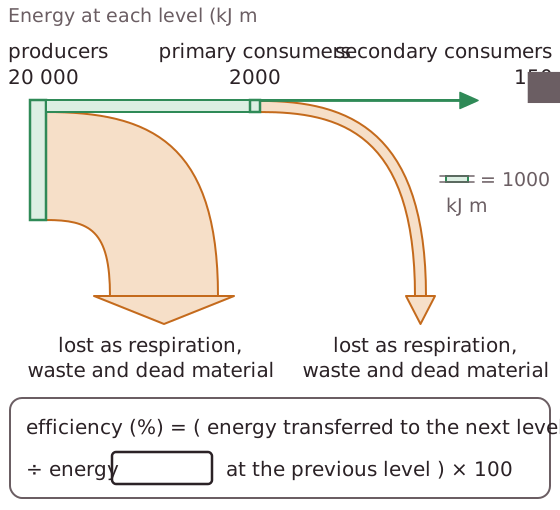
producers to primary consumers = 2000 ÷ 20 000 × 100 = 10%
primary to secondary consumers = 150 ÷ 2000 × 100 = 7.5% The equation can be rearranged to find an unknown energy value:energy transferred = efficiency ÷ 100 × energy available For example, if a secondary consumer level contains 1500 kJ m−2 year−1 and the efficiency of transfer to the tertiary consumers is 8%, the tertiary consumers receive 8 ÷ 100 × 1500 = 120 kJ m−2 year−1.Energy transfers are often shown on an energy flow diagram (Sankey diagram), where the width of each arrow is proportional to the amount of energy. Wide arrows leading off each trophic level show the energy lost in respiration, faeces, urine and dead material, and a narrow arrow shows the small amount passed on.Exam tip: always divide by the energy at the lower (earlier) trophic level.
producers 20 000 → primary consumers 2000 → secondary consumers 150