When core temperature falls below the norm, the hypothalamus triggers responses that reduce heat loss and increase heat production.Reducing heat loss
• Vasoconstriction. Arterioles supplying the skin constrict, so less blood flows near the surface and less heat is lost by radiation (see the vasoconstriction lesson).
• Hairs raised. The hair erector muscles contract and pull the hairs upright. A thicker layer of still air is trapped next to the skin. Air is a poor conductor of heat, so this insulates the body. In humans, who have little body hair, this only produces goose bumps.
• Less sweating. Sweat secretion is reduced, so less heat is lost by evaporation.Increasing heat production
• Shivering. Skeletal muscles contract and relax rapidly and involuntarily. The extra respiration releases heat.
• Raised metabolic rate. Adrenaline gives a quick increase, and more thyroxine is released over longer periods (for example in winter), increasing the rate of respiration in cells, especially in the liver.
• Some mammals, especially newborns and hibernators, have brown fat, which releases energy directly as heat instead of using it to make ATP.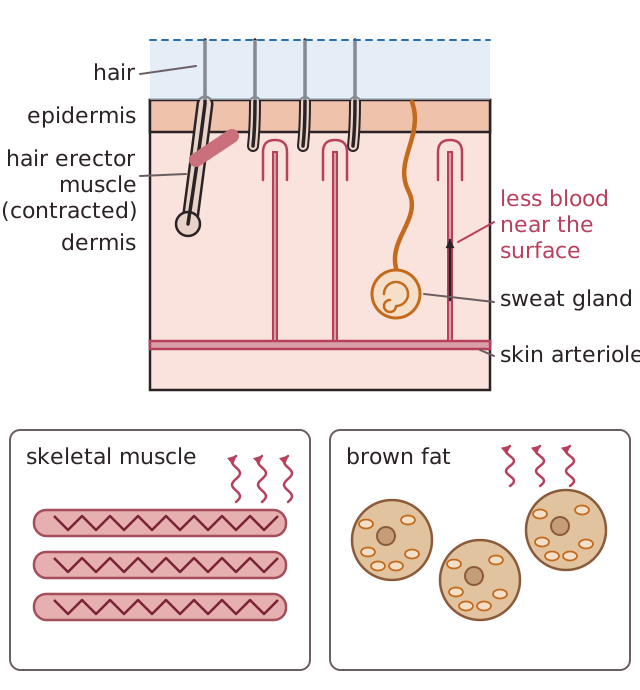 Behaviour. Moving into the sun or into shelter, curling up to reduce the exposed surface area, huddling together and, in humans, putting on more clothes.These responses have a cost: shivering and a raised metabolic rate use up energy stores, so an animal in the cold needs more food.
• Vasoconstriction. Arterioles supplying the skin constrict, so less blood flows near the surface and less heat is lost by radiation (see the vasoconstriction lesson).
• Hairs raised. The hair erector muscles contract and pull the hairs upright. A thicker layer of still air is trapped next to the skin. Air is a poor conductor of heat, so this insulates the body. In humans, who have little body hair, this only produces goose bumps.
• Less sweating. Sweat secretion is reduced, so less heat is lost by evaporation.Increasing heat production
• Shivering. Skeletal muscles contract and relax rapidly and involuntarily. The extra respiration releases heat.
• Raised metabolic rate. Adrenaline gives a quick increase, and more thyroxine is released over longer periods (for example in winter), increasing the rate of respiration in cells, especially in the liver.
• Some mammals, especially newborns and hibernators, have brown fat, which releases energy directly as heat instead of using it to make ATP.
Behaviour. Moving into the sun or into shelter, curling up to reduce the exposed surface area, huddling together and, in humans, putting on more clothes.These responses have a cost: shivering and a raised metabolic rate use up energy stores, so an animal in the cold needs more food.