Vasoconstriction is the narrowing of the arterioles that supply the capillaries near the skin surface. It is a response to a fall in core temperature.When the heat gain centre in the hypothalamus is activated, more impulses are sent along sympathetic nerves to the arterioles in the skin. The ring of smooth muscle in their walls contracts, narrowing the lumen. At the same time the shunt vessels (arteriovenous shunts) dilate, so blood is diverted from the arterioles straight to the venules, deeper in the skin.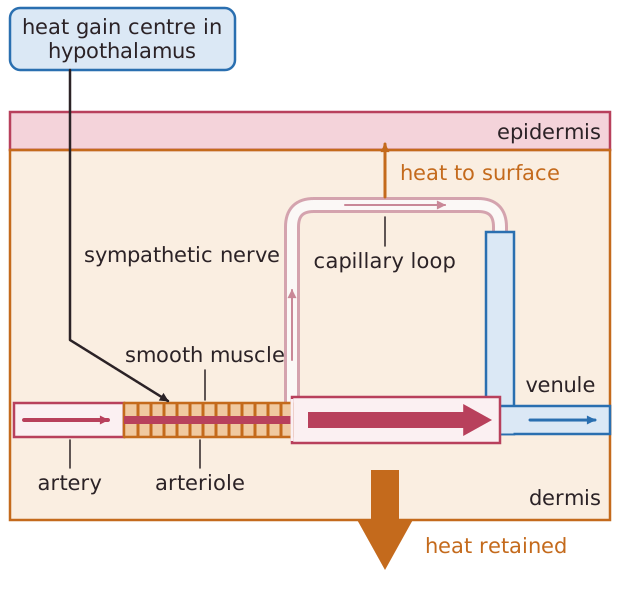 Much less blood flows through the surface capillaries, so less heat is transferred to the skin surface and lost by radiation, conduction and convection. Heat is kept in the core of the body, where the vital organs are. The skin becomes paler and colder, and fingers and toes may feel numb.As with vasodilation, the capillaries themselves do not change: it is the arterioles that constrict.Vasoconstriction has a limit. If the skin is kept very cold for a long time, tissues in the extremities may be starved of oxygen and damaged (frostbite). In very cold fingers, short periods of vasodilation can interrupt vasoconstriction, sending bursts of warm blood that help protect the tissue.Worked example. If blood flow to the skin of the hand falls from 20 cm3 min−1 to 2 cm3 min−1, the flow has fallen by (20 − 2) ÷ 20 × 100 = 90%.