DNA profiling can show whether a man is the biological father of a child.The principle
A child inherits one allele at each STR locus from the mother and one from the father. So every band in a child's DNA profile must be present in either the mother's profile or the biological father's profile.Method
1. DNA profiles are produced for the child, the mother and each possible father, usually from cheek swabs.
2. Any bands in the child's profile that match the mother's are identified.
3. The remaining bands must have come from the father. Each possible father's profile is checked for these bands.
4. If a man is missing any of these paternal bands, he is excluded. If he has them all, at every locus tested, he is very probably the father.Worked example (numbers of repeats at three STR loci)
Locus 1: child 8, 12; mother 8, 10; man A 11, 14; man B 12, 15
Locus 2: child 6, 9; mother 9, 9; man A 6, 7; man B 6, 11
Locus 3: child 13, 16; mother 13, 17; man A 16, 18; man B 16, 16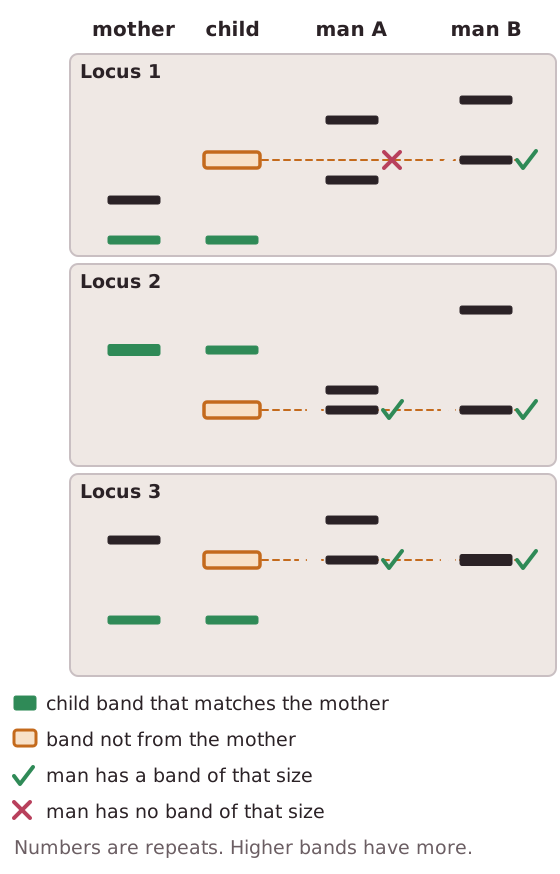 The paternal alleles are 12, 6 and 16. Man A does not have 12 at locus 1, so he is excluded. Man B has 12, 6 and 16, so he could be the father.A single mismatch is enough to exclude a man. A match is expressed as a probability, and using more loci makes the result more certain. Close male relatives of the father, such as his brother, share many of the same bands.
A child inherits one allele at each STR locus from the mother and one from the father. So every band in a child's DNA profile must be present in either the mother's profile or the biological father's profile.Method
1. DNA profiles are produced for the child, the mother and each possible father, usually from cheek swabs.
2. Any bands in the child's profile that match the mother's are identified.
3. The remaining bands must have come from the father. Each possible father's profile is checked for these bands.
4. If a man is missing any of these paternal bands, he is excluded. If he has them all, at every locus tested, he is very probably the father.Worked example (numbers of repeats at three STR loci)
Locus 1: child 8, 12; mother 8, 10; man A 11, 14; man B 12, 15
Locus 2: child 6, 9; mother 9, 9; man A 6, 7; man B 6, 11
Locus 3: child 13, 16; mother 13, 17; man A 16, 18; man B 16, 16
The paternal alleles are 12, 6 and 16. Man A does not have 12 at locus 1, so he is excluded. Man B has 12, 6 and 16, so he could be the father.A single mismatch is enough to exclude a man. A match is expressed as a probability, and using more loci makes the result more certain. Close male relatives of the father, such as his brother, share many of the same bands.