Most of the genome does not code for proteins. Two types of non-coding DNA are important for this topic.Introns
In eukaryotes, most genes contain non-coding sequences called introns between the coding sequences, called exons. The whole gene, introns included, is transcribed into pre-mRNA, and the introns are then removed before translation. Introns are found within genes, and their base sequences can vary between individuals without affecting the protein produced.Satellite DNA
Between genes there are regions where a short base sequence is repeated many times, one after another. These are called tandem repeats or satellite DNA. There are two main types:
• minisatellites, also called variable number tandem repeats (VNTRs): a sequence of about 10 to 100 bases repeated many times
• microsatellites, also called short tandem repeats (STRs): a sequence of just 2 to 6 bases, such as GATA, repeated typically 5 to 50 times.Satellite DNA is found at the same place (locus) on a chromosome in everyone, but the number of repeats varies greatly between individuals. For example, at one STR locus one person may have 8 repeats of GATA and another 13.Because we have two copies of each chromosome, we have two versions of each STR locus, one inherited from each parent. The two versions may have the same or different numbers of repeats.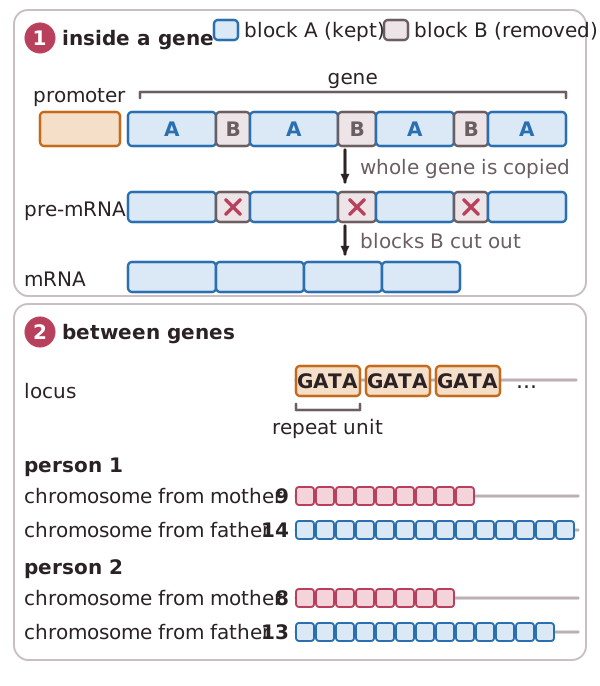 Because these regions do not code for proteins, mutations in them do not affect the phenotype, so a great deal of variation builds up. This makes them ideal for telling people apart.
In eukaryotes, most genes contain non-coding sequences called introns between the coding sequences, called exons. The whole gene, introns included, is transcribed into pre-mRNA, and the introns are then removed before translation. Introns are found within genes, and their base sequences can vary between individuals without affecting the protein produced.Satellite DNA
Between genes there are regions where a short base sequence is repeated many times, one after another. These are called tandem repeats or satellite DNA. There are two main types:
• minisatellites, also called variable number tandem repeats (VNTRs): a sequence of about 10 to 100 bases repeated many times
• microsatellites, also called short tandem repeats (STRs): a sequence of just 2 to 6 bases, such as GATA, repeated typically 5 to 50 times.Satellite DNA is found at the same place (locus) on a chromosome in everyone, but the number of repeats varies greatly between individuals. For example, at one STR locus one person may have 8 repeats of GATA and another 13.Because we have two copies of each chromosome, we have two versions of each STR locus, one inherited from each parent. The two versions may have the same or different numbers of repeats.
Because these regions do not code for proteins, mutations in them do not affect the phenotype, so a great deal of variation builds up. This makes them ideal for telling people apart.