Auxins are a group of plant growth regulators. The main natural auxin is indoleacetic acid (IAA).IAA is made in the meristems at the tips of shoots and roots and in young leaves. It moves away from the tip by diffusion and by active transport from cell to cell, and over longer distances in the phloem. It mainly acts in the zone of elongation just behind the tip.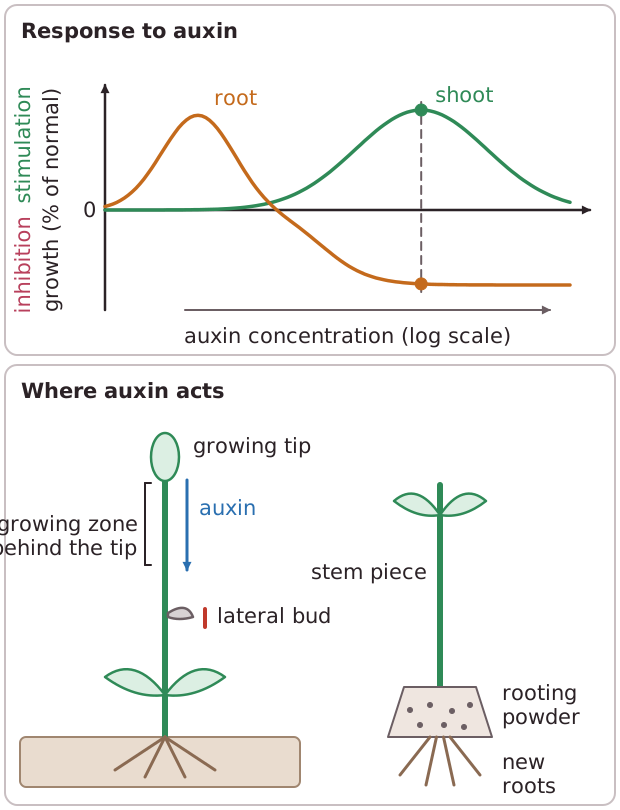 Effects of auxins- Cell elongation in shoots: auxin stimulates shoot cells to elongate, so shoots grow longer.
- Root growth: roots are far more sensitive to auxin than shoots. Very low concentrations stimulate root cell elongation, but the higher concentrations that stimulate shoots inhibit elongation in roots.
- Tropisms: an uneven distribution of auxin causes phototropism in shoots and geotropism in roots.
- Apical dominance: auxin from the shoot tip inhibits the growth of lateral buds.
- Root formation: auxin stimulates roots to form on stem cuttings.
- Fruit development, and inhibition of leaf fall (abscission).The response to auxin depends strongly on its concentration and on the tissue. The same concentration can stimulate growth in a shoot and inhibit it in a root.Commercial uses- Rooting powders containing synthetic auxins help cuttings form roots.
- Synthetic auxins such as 2,4-D are used as selective weedkillers. Broad-leaved weeds absorb more and grow so rapidly and abnormally that they die, while narrow-leaved cereals and grasses are much less affected.
- Auxins can be used to produce seedless fruit without fertilisation.
Effects of auxins- Cell elongation in shoots: auxin stimulates shoot cells to elongate, so shoots grow longer.- Root growth: roots are far more sensitive to auxin than shoots. Very low concentrations stimulate root cell elongation, but the higher concentrations that stimulate shoots inhibit elongation in roots.
- Tropisms: an uneven distribution of auxin causes phototropism in shoots and geotropism in roots.
- Apical dominance: auxin from the shoot tip inhibits the growth of lateral buds.
- Root formation: auxin stimulates roots to form on stem cuttings.
- Fruit development, and inhibition of leaf fall (abscission).The response to auxin depends strongly on its concentration and on the tissue. The same concentration can stimulate growth in a shoot and inhibit it in a root.Commercial uses- Rooting powders containing synthetic auxins help cuttings form roots.
- Synthetic auxins such as 2,4-D are used as selective weedkillers. Broad-leaved weeds absorb more and grow so rapidly and abnormally that they die, while narrow-leaved cereals and grasses are much less affected.
- Auxins can be used to produce seedless fruit without fertilisation.