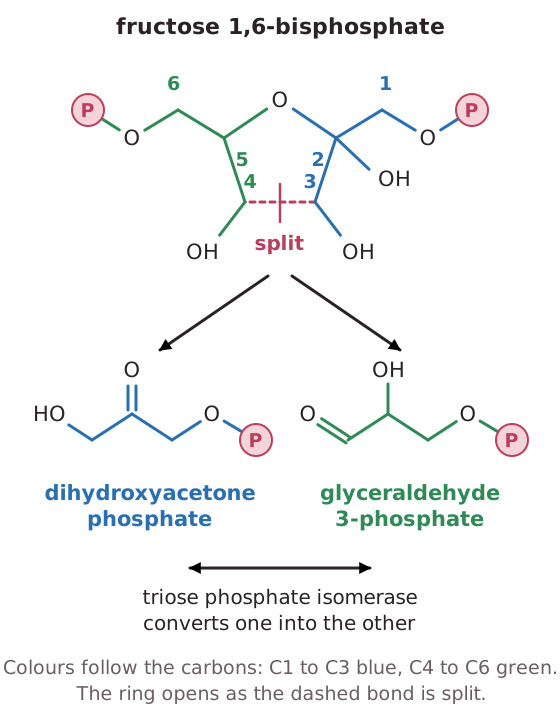
Lysis is the second stage of glycolysis. Like the rest of glycolysis, it takes place in the cytoplasm of the cell and does not need oxygen.In the first stage, glucose is phosphorylated using two molecules of ATP to form hexose bisphosphate (fructose 1,6-bisphosphate). The two phosphate groups make the molecule less stable and easier to split.During lysis, each 6-carbon hexose bisphosphate molecule is split into two 3-carbon molecules of triose phosphate. Each triose phosphate carries one of the phosphate groups.Two slightly different triose phosphates are formed at first (glyceraldehyde 3-phosphate and dihydroxyacetone phosphate). The enzyme triose phosphate isomerase converts one into the other, so both can continue through glycolysis as the same molecule.No ATP is used or made during lysis itself. By this point glycolysis has used 2 ATP per glucose, and these are regained in the next stage when triose phosphate is oxidised.