Skip to content

ATP Synthase

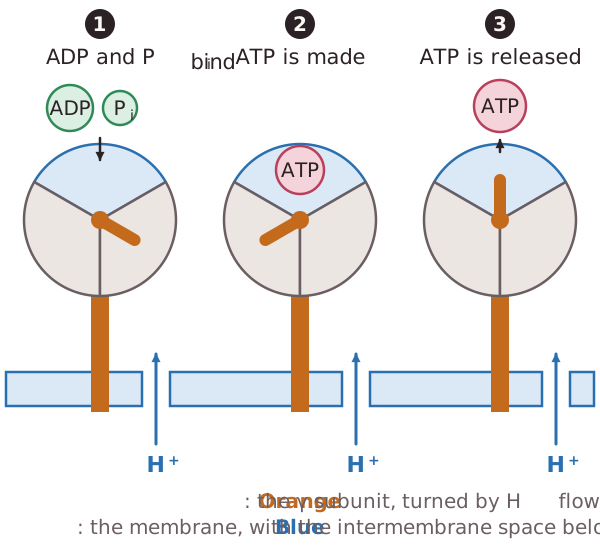
The production of ATP from ADP and inorganic phosphate using the energy from the proton gradient across the inner membrane of the mitochondria is called chemiosmosis.ATP synthase is a proton channel. The molecule has three identical subunits and a gamma subunit. As H+ ions pass through the hydrophilic pore the gamma subunit rotates, causing each of the three subunits in turn to go through three conformational changes. About three H+ ions are needed for each ATP made. The first allows the binding of ADP and inorganic phosphate. The second causes ATP to be produced and the third causes ATP to be released from the binding site.
Read the text

Read the text and highlight anything you think is important. When you go on, the text is hidden and you answer from memory.

Specification: AQA Biology (7402), A-level, 3.5.2 Respiration. Topic: Respiration.

Key terms in this lesson

myofibril
A long, cylindrical, rod-like organelle within a muscle fibre, made of actin and myosin filaments, that is the contractile element of the fibre.
actin
A thin protein myofilament in a myofibril that, together with myosin, slides during muscle contraction; its myosin-binding sites are covered by tropomyosin in resting muscle.
myosin
A thick protein myofilament with a hinged globular head that binds to actin and ATP and pulls actin filaments during muscle contraction.

More in Respiration

All 12 lessons in Respiration · All AQA A-level Biology topics