- Auxins are used to produce seedless fruit.
- Ethene is used to promote fruit dropping in cotton, walnuts, cherries etc.
- Cytokinins are used to prevent ageing of ripe fruit and to control tissue development in micropropagation.
- Gibberellins are used to delay ripening and ageing in fruit, to speed up the malting process in beer brewing and to improve the shape and size of fruits.
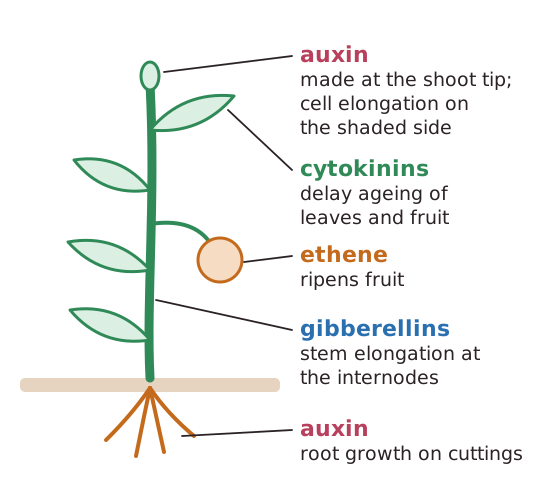
Other Uses of Plant Hormones
Read the text
Read the text and highlight anything you think is important. When you go on, the text is hidden and you answer from memory.
Specification: AQA Biology (7402), A-level, 3.6.1.1 Survival and response. Topic: Plant Responses.
Key terms in this lesson
- auxin
- A plant growth hormone, produced at the tips of shoots and roots, that stimulates cell elongation, maintains apical dominance and controls tropisms.
- gibberellin
- A plant growth hormone that stimulates stem elongation, breaks seed dormancy and triggers the mobilisation of food stores during germination.
- ethene
- A gaseous plant hormone that causes fruit ripening and leaf fall (abscission).
- electron transport chain
- A series of protein complexes in the inner mitochondrial (or thylakoid) membrane that pass electrons along a chain of redox reactions, pumping protons across the membrane to generate a proton gradient.
More in Plant Responses
- Pheromones
- Response to Touch
- Tropisms
- Growing in the Dark
- Geotropism
- Fruit Ripening
- Rooting Powder
- Hormonal Weedkillers
All 19 lessons in Plant Responses · All AQA A-level Biology topics