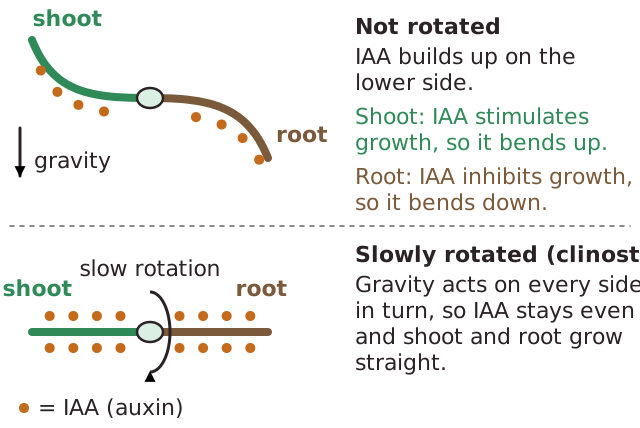
Plants respond to gravity by directional growth called geotropism (also called gravitropism). Shoots are negatively geotropic and grow upwards, away from gravity. Roots are positively geotropic and grow downwards, towards gravity.This means roots grow down into the soil, where they anchor the plant and absorb water and mineral ions, while shoots grow up towards the light needed for photosynthesis.The response is controlled by auxins such as indoleacetic acid (IAA). When a plant is placed on its side, IAA accumulates on the lower side of both the shoot and the root.In the shoot, the higher concentration of IAA on the lower side stimulates cell elongation, so the lower side grows faster and the shoot bends upwards. In the root, a high concentration of IAA inhibits cell elongation, so the upper side grows faster and the root bends downwards.If a seedling on its side is slowly rotated on a clinostat, gravity acts equally on all sides, IAA stays evenly distributed and the shoot and root grow straight.