Eutrophication is the process by which nutrients build up in a body of water, leading to an increase in the growth of algae and, eventually, the death of aerobic organisms. It is often caused by nitrate leached from farmland, and it happens in a sequence of steps.1. In most lakes and rivers, nitrate is naturally scarce, so it is a limiting factor for the growth of plants and algae.
2. Leaching adds large amounts of nitrate, so it is no longer limiting. Algae grow rapidly, especially at the surface, forming an algal bloom.
3. The dense algae block light from reaching plants lower in the water.
4. These plants cannot photosynthesise enough, so they die.
5. There is now plenty of dead organic matter, so the population of saprobiotic bacteria increases as they decompose it.
6. These bacteria respire aerobically, so their demand for oxygen rises and the concentration of dissolved oxygen in the water falls.
7. Fish and other aerobic organisms die from lack of oxygen.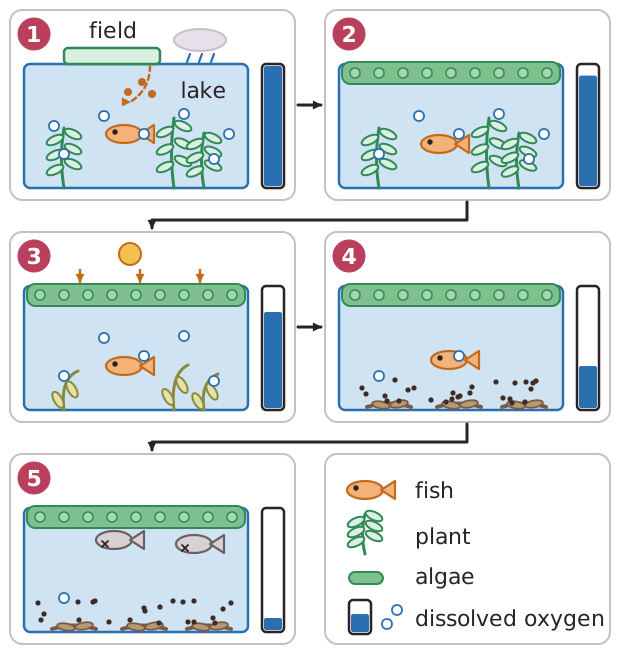 A key idea is that the algae are not what kills the fish directly. The fish die because the aerobic respiration of saprobionts uses up the oxygen.Phosphate reaching water, for example in run-off, sewage or detergents, can cause eutrophication in the same way, because phosphate is also often a limiting ion in fresh water.
2. Leaching adds large amounts of nitrate, so it is no longer limiting. Algae grow rapidly, especially at the surface, forming an algal bloom.
3. The dense algae block light from reaching plants lower in the water.
4. These plants cannot photosynthesise enough, so they die.
5. There is now plenty of dead organic matter, so the population of saprobiotic bacteria increases as they decompose it.
6. These bacteria respire aerobically, so their demand for oxygen rises and the concentration of dissolved oxygen in the water falls.
7. Fish and other aerobic organisms die from lack of oxygen.
A key idea is that the algae are not what kills the fish directly. The fish die because the aerobic respiration of saprobionts uses up the oxygen.Phosphate reaching water, for example in run-off, sewage or detergents, can cause eutrophication in the same way, because phosphate is also often a limiting ion in fresh water.