Motor neurones transmit impulses from either relay neurones or sensory neurones to effectors.Effectors bring about responses and are either muscles or glands.Most electrical impulses travel from receptor to sensory neurone to relay neurone to motor neurone to effector cell.Motor neurones have a long axon and many short dendrites.
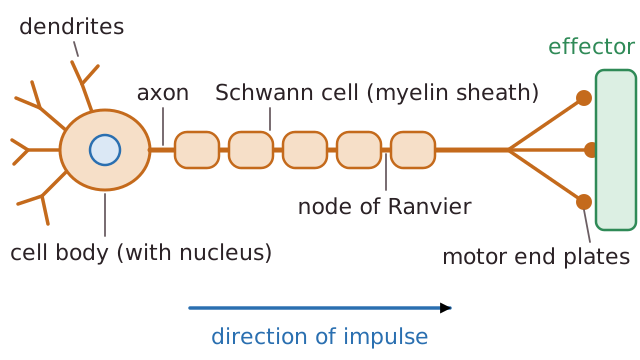
The motor neurones that stimulate skeletal muscles tend to be myelinated.
Motor Neurones
Read the text
Read the text and highlight anything you think is important. When you go on, the text is hidden and you answer from memory.
Specification: AQA Biology (7402), A-level, 3.6.2.1 Nerve impulses. Topic: Neuronal Communication.
Key terms in this lesson
- ATP
- Adenosine triphosphate, the universal energy currency of cells, formed by adding an inorganic phosphate to ADP and hydrolysed to release energy for cellular reactions.
- ATP synthase
- An enzyme that spans a membrane and synthesises ATP from ADP and inorganic phosphate as protons flow through it down their concentration gradient.
More in Neuronal Communication
- Cell Signalling
- The Nervous System
- Neurones
- Sensory Neurones
- Myelinated Neurones
- Sensory Receptors
- Pacinian Corpuscles
- Generator Potential
All 38 lessons in Neuronal Communication · All AQA A-level Biology topics