 BRAINCAKE
The Power Stroke
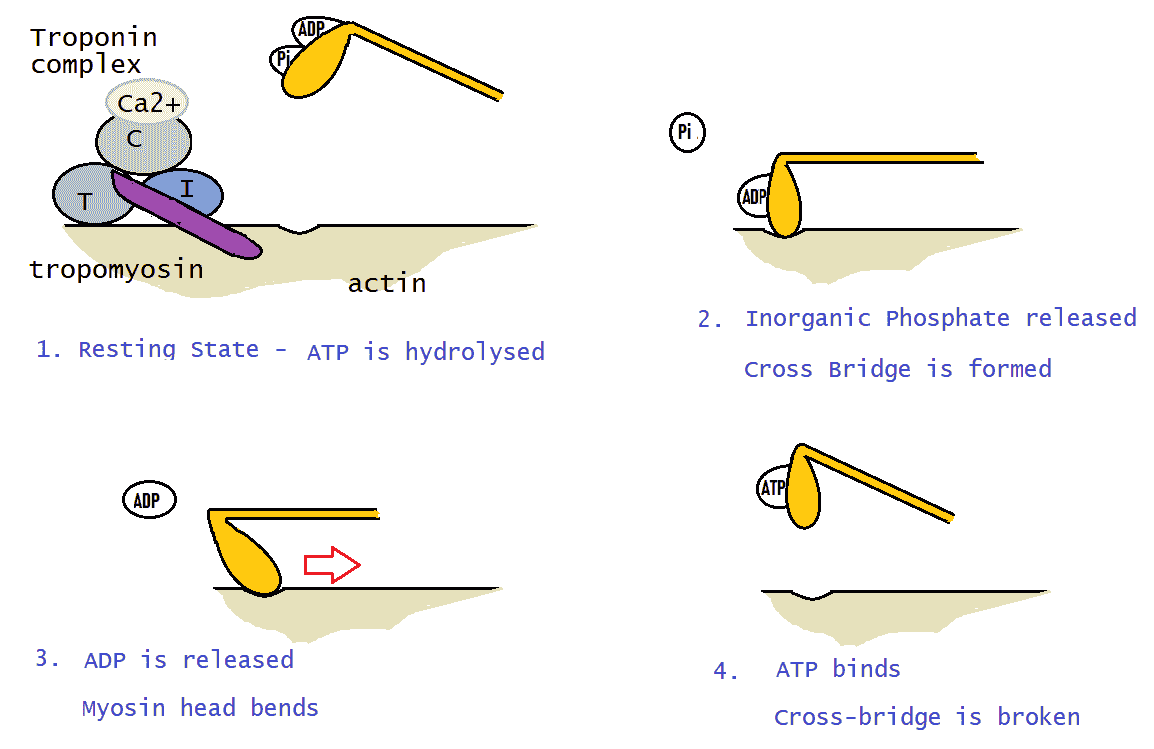
In the resting state the myosin head has ADP and Pi bound. Once the binding site is exposed the myosin head releases Pi and binds to the actin molecule forming a cross-bridge. ADP is released and the head bends pulling the actin towards the middle of the sarcomere. The binding of ATP breaks the cross-bridge and the myosin head detaches. Hydrolysis of ATP returns the myosin head to its resting state. It is then free to bind to another binding site further along.
Sign in free to see the rest of this lesson, the R.E.C.I.P.E. recall steps and the quiz
BrainCake is free. Make an account in seconds and pick up where this page stops.
Key terms in this lesson
- sarcomere
- The contractile unit of a myofibril, delineated by two Z-lines, containing overlapping actin and myosin filaments.
- actin
- A thin protein myofilament in a myofibril that, together with myosin, slides during muscle contraction; its myosin-binding sites are covered by tropomyosin in resting muscle.
- myosin
- A thick protein myofilament with a hinged globular head that binds to actin and ATP and pulls actin filaments during muscle contraction.
- ATP
- Adenosine triphosphate, the universal energy currency of cells, formed by adding an inorganic phosphate to ADP and hydrolysed to release energy for cellular reactions.