Skip to content

Actin

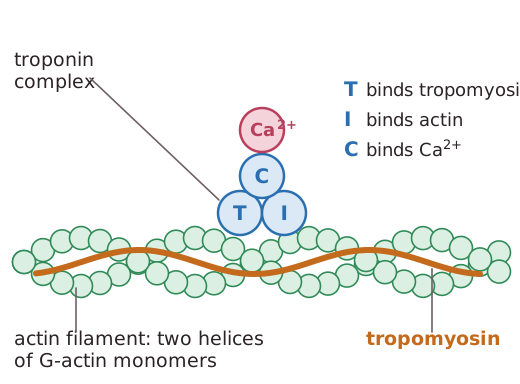
Myofibrils are made from two types of protein filaments (myofilaments), the thinner actin filament and the thicker myosin filaments. The monomer G-Actin (globular) forms a linear polymer F-Actin (filamentous) which forms two helices that spiral round each other. Actin filaments have myosin binding sites which are blocked by rod-shaped proteins called tropomyosin. Tropomyosin is held in place by the Troponin complex. This is a globular protein with 3 subunits. The I subunit binds to actin and the T subunit binds to tropomyosin. The C subunit binds to calcium ions.
Read the text

Read the text and highlight anything you think is important. When you go on, the text is hidden and you answer from memory.

Specification: AQA Biology (7402), A-level, 3.6.3 Skeletal muscles are stimulated to contract by nerves and act as. Topic: Muscles.

Key terms in this lesson

decarboxylation
The removal of carbon dioxide from a molecule, such as pyruvate during the link reaction or intermediates in the Krebs cycle.
dehydrogenation
The removal of hydrogen atoms from a molecule, typically coupled with the reduction of a coenzyme such as NAD or FAD.
ATP
Adenosine triphosphate, the universal energy currency of cells, formed by adding an inorganic phosphate to ADP and hydrolysed to release energy for cellular reactions.

More in Muscles

All 15 lessons in Muscles · All AQA A-level Biology topics