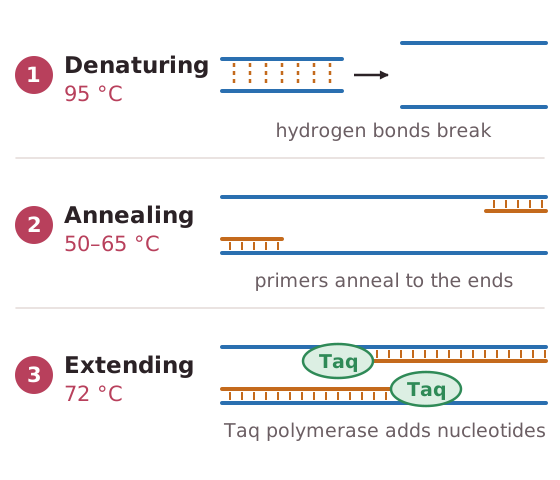
In the past, at least 1μg of DNA was required for DNA profiling. With PCR, only tiny amounts of DNA are needed as DNA can be replicated from very small amounts.Amplification is achieved first by denaturing the DNA i.e. separating the strands at 95°C into single-stranded DNA by breaking the hydrogen bonds. Then DNA primers are then added to the ends at 50-65°C. The primers anneal to the ends of the single-stranded DNA. Nucleotides are added and the temperature is raised to 72-75°C for about a minute so the Taq DNA polymerase can add nucleotides to the primer. The DNA polymerase used comes from Thermus aquaticus, a bacterium found in hot springs. The Taq DNA polymerase has an optimum temperature of about 72°C.
The Polymerase Chain Reaction
Read the text
Read the text and highlight anything you think is important. When you go on, the text is hidden and you answer from memory.
Specification: AQA Biology (7402), A-level, 3.8.4.1 Recombinant DNA technology. Topic: Genetic Engineering and Biotechnology.
Key terms in this lesson
- vector
- A vehicle, such as a plasmid or virus, used to carry a gene of interest into a host cell during genetic engineering.
- transcription factor
- A protein that binds to a specific DNA base sequence and stimulates or inhibits the transcription of a gene.
More in Genetic Engineering and Biotechnology
- Non-coding DNA
- Gel Electrophoresis
- DNA Profiling
- DNA Sequencing
- Automated Sequencing
- Pathogens, DNA Barcoding
- Genomics and Proteomics
- Recombinant DNA
All 23 lessons in Genetic Engineering and Biotechnology · All AQA A-level Biology topics