Skip to content

DNA Sequencing

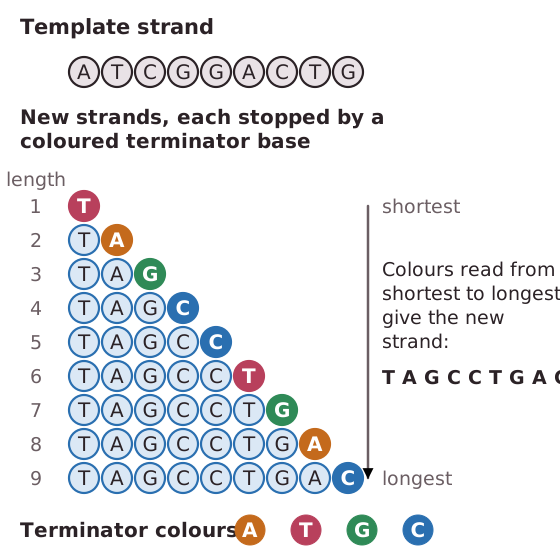
The idea of DNA sequencing is to work out the order of nucleotide bases in DNA. This was first done by Sanger et al. who sequenced 500-800 bases at a time and won the Nobel prize in 1980. The Human Genome Project was established in 1990 and was completed more quickly than expected due to the automation of sequencing techniques.The DNA to be sequenced is mixed with primers, nucleotides, DNA polymerase and terminator bases. Terminator bases will stop DNA synthesis and have coloured fluorescent tags for identification. The mixture is placed in a thermal cycler. At 96°C the strands separate, at 50°C the primers anneal and at 60°C DNA polymerase adds nucleotides to the primers. Each time a terminator base is incorporated the chain terminates so after many cycles DNA of all possible lengths is obtained.
Read the text

Read the text and highlight anything you think is important. When you go on, the text is hidden and you answer from memory.

Specification: AQA Biology (7402), A-level, 3.8.3 Using genome projects. Topic: Genetic Engineering and Biotechnology.

Key terms in this lesson

multipotent
Describes a stem cell, found in mature mammals, that can divide and differentiate into a limited number of cell types, usually within one tissue.
insulin
A hormone secreted by the beta cells of the islets of Langerhans in response to a rise in blood glucose concentration, which lowers blood glucose by stimulating cells to take up and use or store glucose.

More in Genetic Engineering and Biotechnology

All 23 lessons in Genetic Engineering and Biotechnology · All AQA A-level Biology topics