Skip to content

Chloroplasts

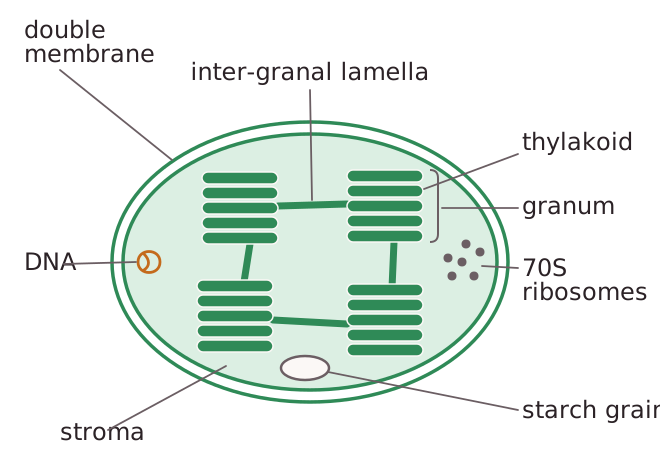
Chloroplasts are the site of photosynthesis. Chloroplasts are disc-shaped, 2-10 μm in diameter, about 1 μm thick and are surrounded by a double membrane.The light-dependent stage of photosynthesis takes place in the grana which are stacks of flattened discs called thylakoids. The thylakoids contain the photosynthetic pigment - chlorophyll and other photosynthetic pigments. Some thylakoids are joined to thylakoids in adjacent grana by inter-granal lamellae.The chloroplasts are filled with a fluid matrix called the stroma in which the light-independent reaction takes place. The chloroplast contains its own DNA and 70S ribosomes. The stroma may contain starch grains.
Read the text

Read the text and highlight anything you think is important. When you go on, the text is hidden and you answer from memory.

Specification: AQA Biology (7402), A-level, 3.5.1 Photosynthesis. Topic: Energy for Biological Processes.

Key terms in this lesson

neurotransmitter
A chemical released by a presynaptic neurone that diffuses across a synapse and binds to receptors on the postsynaptic cell, altering its membrane potential.
neuromuscular junction
The synapse between a motor neurone and a skeletal muscle fibre, where acetylcholine triggers depolarisation of the sarcolemma.
hormone
A chemical messenger, secreted by an endocrine gland directly into the blood, that travels to target cells bearing complementary receptors and brings about a response.
insulin
A hormone secreted by the beta cells of the islets of Langerhans in response to a rise in blood glucose concentration, which lowers blood glucose by stimulating cells to take up and use or store glucose.

More in Energy for Biological Processes

All 17 lessons in Energy for Biological Processes · All AQA A-level Biology topics