Chemiosmosis is the synthesis of ATP driven by the flow of protons (H+) down a gradient across a membrane. In the chloroplast it is the final stage of the light-dependent reactions.As excited electrons pass along the electron transport chain in the thylakoid membrane, they lose energy. This energy is used to pump protons from the stroma into the thylakoid space. Protons are also released into the thylakoid space by the photolysis of water. The thylakoid membrane is impermeable to protons, so a high concentration of protons builds up inside the thylakoid and a proton gradient forms across the membrane.There are 'stalked particles' or ATP synthase in the thylakoid membrane. ATP synthase is a proton channel and an enzyme. For every three protons that pass through the channel, one molecule of ATP is made from ADP and inorganic phosphate.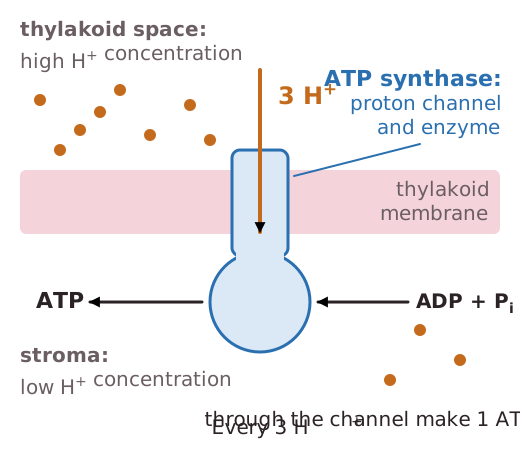 Protons can only diffuse back into the stroma through the channel in ATP synthase. As they flow down the proton gradient they provide the energy to join ADP and inorganic phosphate (Pi), so ATP is made in the stroma, where it is used in the Calvin cycle.Making ATP in this way, using energy that came from light, is called photophosphorylation.