ATP and reduced NADP from the light-dependent reactions are used in the Calvin cycle which is a light-independent process. The three main stages are carbon dioxide fixation - the combination of carbon dioxide with 5-carbon ribulose bisphosphate (RuBP) to form a 6C compound, the splitting into two 3carbon molecules and the reduction of the glycerate phosphate subsequently formed to form triose phosphate and the regeneration of RuBP so that the cycle can continue. Rubisco, the enzyme that catalyses CO2 fixation, is the rate-limiting enzyme in photosynthesis.ATP and reduced NADP from the light dependent reactions are used to reduce glycerate phosphate (GP) to triose phosphate(TP) The triose phosphate is then used to make glucose, amino-acids and fatty acids.
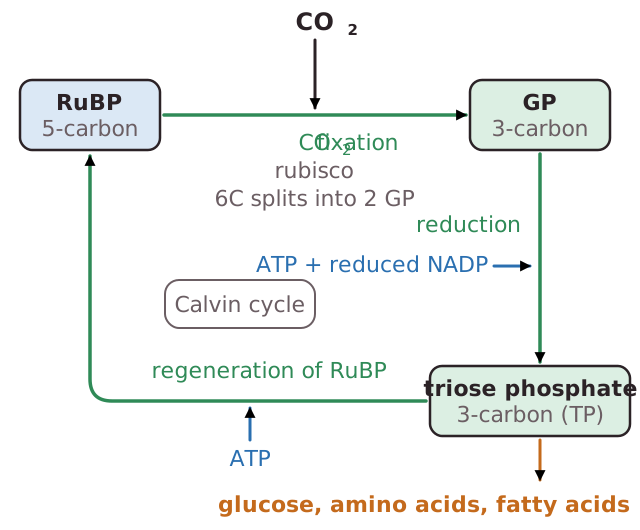
Calvin Cycle
Read the text
Read the text and highlight anything you think is important. When you go on, the text is hidden and you answer from memory.
Specification: AQA Biology (7402), A-level, 3.5.1 Photosynthesis. Topic: Energy for Biological Processes.
Key terms in this lesson
- Schwann cell
- A cell that wraps around an axon to form the myelin sheath, and which also carries out phagocytosis of debris and assists nerve regeneration.
- node of Ranvier
- A small gap between adjacent Schwann cells on a myelinated axon where the axon membrane is exposed and depolarisation can occur.
More in Energy for Biological Processes
- Photosystems
- Cyclic Photophosphorylation
- Non-cyclic Photophosphorylation
- Chemiosmosis
- Limiting Factors of Photosynthesis
- Light Intensity as a Limiting Factor
- Carbon Dioxide Concentration as a Limiting Factor
- Temperature as a Limiting Factor
All 17 lessons in Energy for Biological Processes · All AQA A-level Biology topics