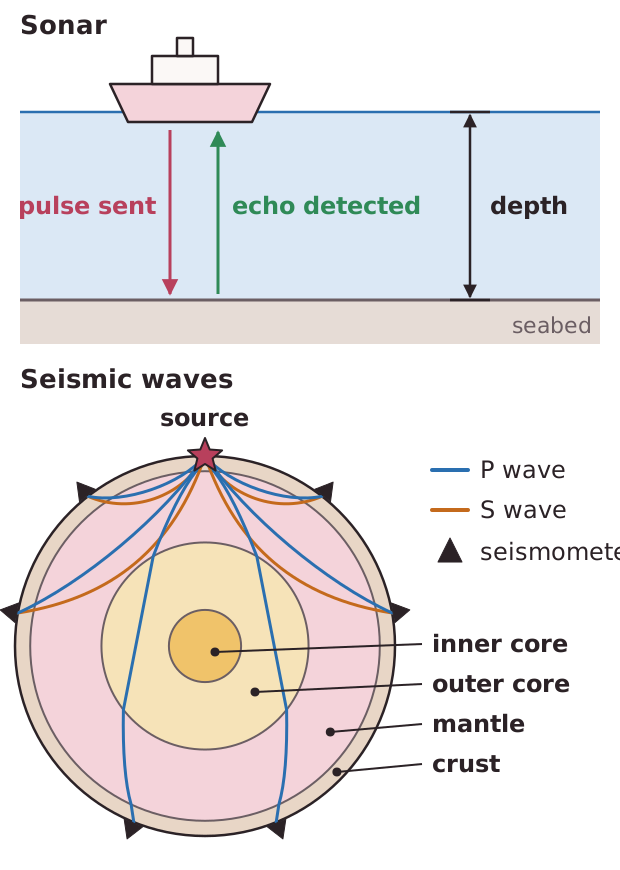
Waves can be used to explore structures we cannot see directly, such as the inside of the Earth or the deep sea. When a wave travels through a material it can be absorbed, reflected at a boundary, or refracted because its speed changes. Different materials behave differently, and these differences give us information.
Earthquakes produce seismic waves. P waves are longitudinal waves that travel through both solids and liquids, and they are faster than S waves. S waves are transverse waves that travel only through solids. After an earthquake, seismometers around the world detect the waves, with the P waves arriving first. Seismic waves are refracted at boundaries between layers of the Earth, so their paths bend. S waves are not detected on the far side of the Earth, which shows that the outer part of the core is liquid.
Sonar is used to explore deep water. A ship sends out a pulse of ultrasound, which is reflected from the seabed or from objects such as wrecks. The time between sending the pulse and detecting the echo is measured. The pulse travels there and back, so depth = speed of sound in water × time ÷ 2. For example, with the speed of sound in sea water taken as 1500 m/s, an echo that returns after 0.2 s means the water is 150 m deep.