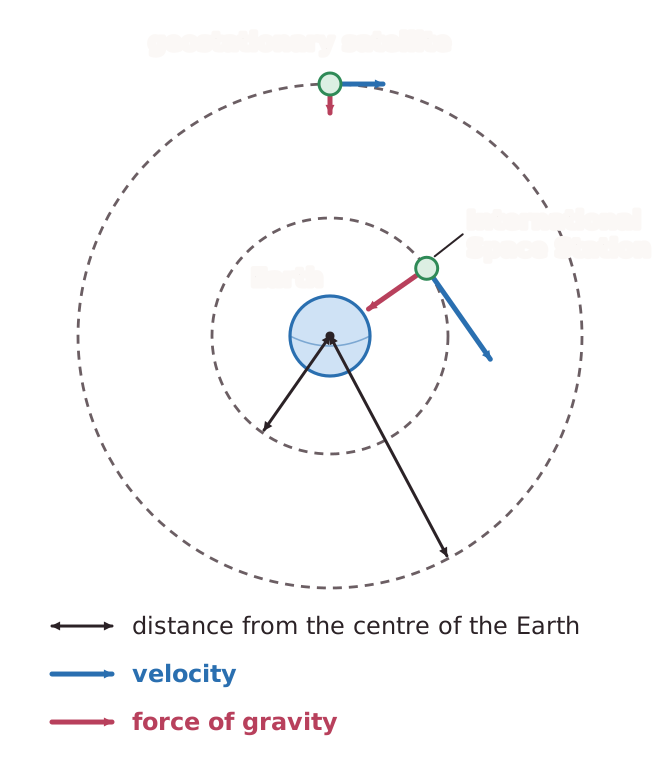
A planet, moon or satellite stays in a stable orbit when gravity is exactly the pull needed to keep it moving round in a circle. Gravity acts towards the centre of the orbit, so for a circular orbit it changes the direction of the motion but not the speed.
For any one orbital radius, there is only one speed that gives a stable circular orbit. Close to the body being orbited, the pull of gravity is stronger, so the orbiting object must travel faster. Further away, the pull of gravity is weaker, so the object must travel slower.
This means the speed and the radius of a stable orbit are linked. If the speed of an orbiting object is larger, its stable orbit must have a smaller radius. If the speed is smaller, its stable orbit must have a larger radius. For example, the International Space Station orbits close to Earth at about 7.7 km/s, while a geostationary satellite, which is much further out, travels at only about 3.1 km/s.